Key Takeaways
- The best way to ask for donations is to name a clear, specific amount based on the alignment you discovered in earlier conversations, then pause to give the donor room to respond.
- Great fundraising is an offer, not an ask. You are inviting an aligned donor into a change they want to make or see in their community. The focus is less on what the donor wants for themselves and more on what they want to accomplish.
- An ask should never come as a surprise. If you invited a donor to an advice meeting, keep it about advice.
- A donor’s hesitation is information, not something to overcome. Get curious, make it easy for the donor to say “no,” and prepare for every possible answer.
- The energy you bring matters more than your script. Fear and discomfort pull us out of connection and get in the way of building relationships and making the right ask.
To ask for donations, find donors who are aligned with your mission, invite them honestly, and learn what they care about and want to accomplish. Then ask a few permission questions that lead to a clear, specific amount based on that alignment, and pause while they respond. When you ask this way, the donor makes a conscious choice, and nobody feels ambushed, including you.
Before my first big ask, I sat in my car feeling sick. I got the gift and still decided I was a terrible fundraiser because I thought good fundraisers never felt like that. Since then, I’ve learned the fear usually comes from two places. One is the natural stress response we all have around talking about money and asking for things, which is a normal part of fundraising. The other is the transactional way many of us were taught to fundraise, which feels misaligned and makes the fear worse. The alignment fundraising approach I teach (inviting donors whose goals truly overlap with your mission) feels better for fundraisers and for donors, and this post walks you through it.
Table of Contents
- Why Does Asking for Donations Matter So Much?
- Why Should You Think of the Ask as an Offer?
- Who Should You Ask for Donations?
- How Do You Ask for Donations, Step by Step?
- What Should You Say When You Make the Ask?
- How Do You Respond When a Donor Hesitates?
- How Do You Get Past the Fear of Asking?
- When Is the Right Time to Ask?
- Should You Ask in Person, by Phone, Email or Text?
- Donation Request Templates You Can Adapt
- What Mistakes Should You Avoid?
- How Do You Get Better at Asking for Money?
- Frequently Asked Questions
Why Does Asking for Donations Matter So Much?
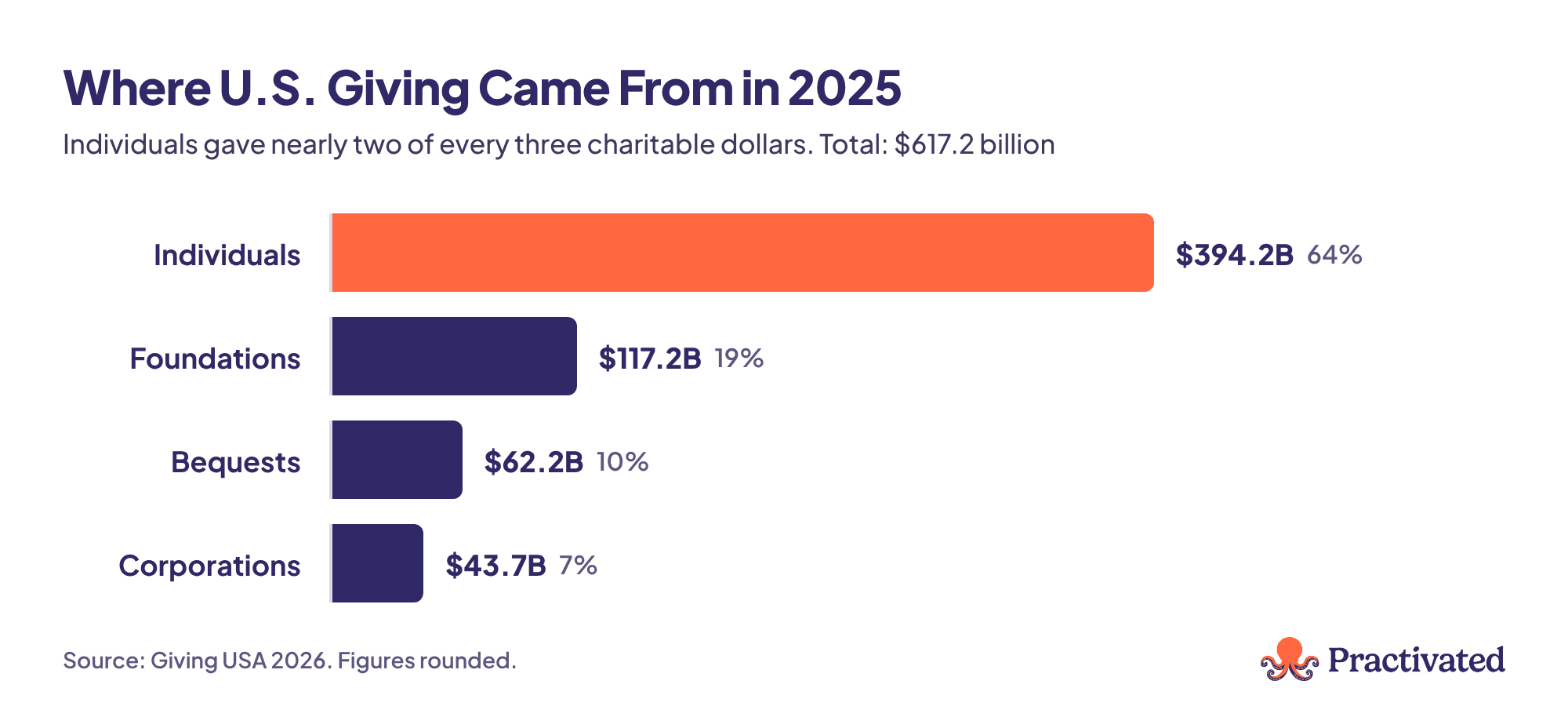
Because individuals provide most of the money, and many organizations don’t ask well. According to Giving USA 2026, as reported by NonProfit PRO, U.S. charitable giving reached an estimated $617.2 billion in 2025, and individuals gave $394.2 billion of it.
Keeping donors is just as hard as finding them. The Fundraising Effectiveness Project, a collaboration of the Association of Fundraising Professionals (AFP) and GivingTuesday, found overall donor retention of 43.3% in 2025 and donor counts down an estimated 3.6%, even as dollars rose, according to its Q4 2025 report, as summarized by DonorPerfect. Fewer donors are giving more, so every conversation counts.
Why Should You Think of the Ask as an Offer?
Because the “ask” frame puts all the power on the donor’s side of the table, and that imbalance is what makes asking so scary. As I write in my book, What the Fundraising, “great fundraising is not an ask; it’s an offer.”
An offer means you believe you’re inviting someone into something of real value that fits what they care about. It is not a trick to squeeze out a gift. The steps can look the same, but the belief underneath them changes, and donors feel it.
| Ask mindset | Offer mindset |
|---|---|
| “I need something from you.” | “I think there’s something here for both of us.” |
| The donor holds all the power. | Both sides bring value. |
| Every “no” means I failed. | A “no” means it wasn’t the right fit. |
| Avoid talking about money. | Talk about money openly, with permission. |
The Community-Centric Fundraising movement makes a related point in its 10 principles: treat donors as partners, be transparent with them, and keep the wider community at the center of the work.
Who Should You Ask for Donations?
Ask the people and partners who are genuinely aligned with your work, not just the ones who look like they should fund you.
Check Alignment Before You Ask
My strongest funder relationships matched on at least three of these five layers of alignment:
- Values: shared in practice, not just on paper
- Mission: the same North Star
- Tactics or strategy: belief in how you do the work
- Tracking and reporting: measuring success the same way
- Assets: valuing what you already offer
Three or more matching layers signal a strong prospect. One or two is a long shot. A mismatch is information, not a failure.
Know What You Bring
Your organization holds more value than you think: engaged audiences, volunteers, expertise, impact data, and stories. When you name those assets, you no longer walk in empty-handed.
Individuals Closest to Your Mission
Current and lapsed donors, board members, volunteers, and grateful constituents often already show alignment. Confirm it in conversation rather than assuming it.
Foundations and Companies
It’s easy to think of these as “application only,” but they also decide through relationships. They just look through a different lens: foundations want vision and results on their priorities, and companies weigh audience, brand, and employee engagement. When a meeting is framed around partnership, they’re often ready to talk about investment early. With foundations, try to meet before you apply.
How Do You Ask for Donations, Step by Step?
A great ask is a series of small, honest permissions, each a gate the donor chooses to walk through, ending with a clear number, then a pause. I sum it up in three words: “permission, gate, go.”
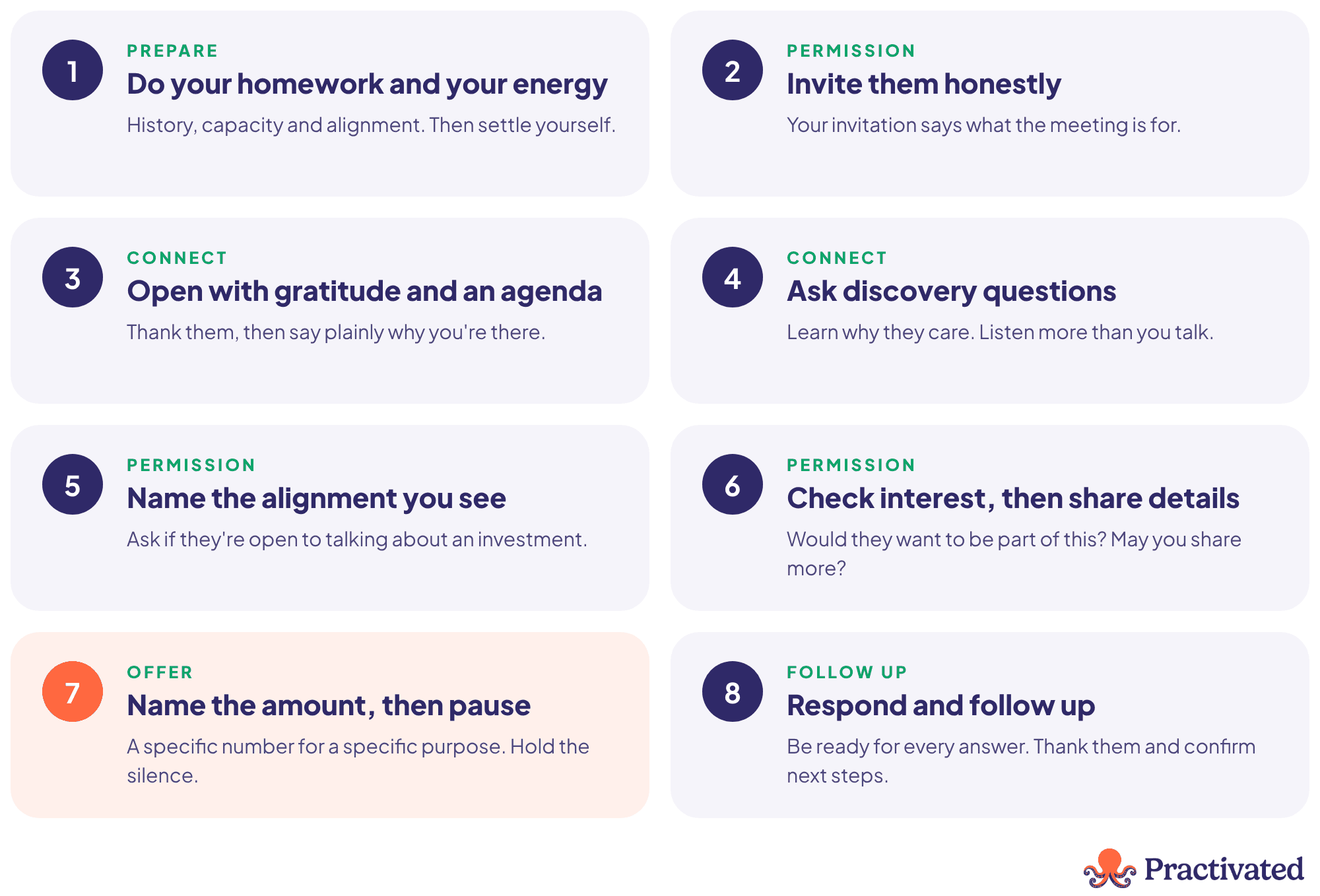
- Do your homework, and prepare your energy. Review giving history, capacity, and alignment. Decide on a specific amount based on the alignment you’ve found, and know what a smaller gift would fund. Then build in buffer time so you arrive settled.
- Invite them honestly. Let your outreach say what the meeting is for: getting to know each other, listening, or talking about investment. Then make sure the meeting matches the invitation.
- Open with gratitude and an agenda. Thank them and say plainly what you hope to cover. When there are no surprises, most of the fear leaves the room.
- Ask discovery questions. “How did you first get involved?” “What do you love most, and what would you change?” Knowing these answers helps before you ask an individual for a gift.
- Name the alignment you see, and ask permission to talk about investment. Connect what they told you to the work, then check in: “Would you be open to hearing about a way you could be part of this?”
- Check interest, then ask to share details. “Does this sound like something you’d want to be involved in?” If yes: “Can I share a bit more about what that would look like?”
- Name the amount, then pause. State the total need and the part you hope they’ll take on. Leave out caveats and justifications, and give the donor room to respond.
- Respond to what you hear, then follow up. Be ready for every answer (more on that below). Thank them quickly, recap what you agreed to, and do exactly what you said you would do.
One exception: if a donor asks, “What would it take?” they have invited the ask. Answer honestly, and check whether they’d like to talk now or set a time.
A leader in one of my coaching groups wanted to ask a steady mid-level donor for a far larger gift. We walked through it together. She would open with why the gift matters now, ask for small permissions one at a time (“Are you open to hearing it?”), admit her nerves, then say the number and pause. She also prepared for each likely answer, including what a smaller gift would pay for.
What Should You Say When You Make the Ask?
Say the amount, the change it makes possible, and the invitation in one or two sentences. By this point the donor has already said yes to hearing it, so you don’t need to cushion it.
Examples to adapt to your own language:
- Major gift: “We need $250,000 to launch the nurse residency program, and we’re looking for five founding partners. I’d love for you to be one of them at $50,000.”
- Annual leadership gift: “Based on what you shared about first-generation students, would you consider a gift of $5,000 this year to support two scholarships?”
Then pause. The urge to fill the silence is a stress response, and talking through the silence often lowers the ask before the donor says a word. It’s best to skip caveats like “any amount would help.”
How Do You Respond When a Donor Hesitates?
Treat hesitation as information, not an objection to overcome. Much online advice teaches you to “overcome objections.” I don’t, because a “no” you talk your way past isn’t the right “yes,” and it costs trust. Get curious, make it easy for the donor to say “no,” and know how you’ll respond to each answer before you walk in.
| What the donor says | What to do next |
|---|---|
| “Yes.” | Thank them warmly and agree on next steps together. |
| “I need to think about it.” | Ask what information would help, and book the next conversation. |
| “That’s more than I can do.” | Offer a lower level, a few options, or a nonmonetary role. Know what a smaller gift would fund. |
| “Not right now.” | Ask about timing, and when it would make sense to talk again. |
| Silence | Give them time. They are thinking, so let them speak first. |
What if you get a fast “yes”? In my Power Partners Formula course, I put it plainly: “if you get a quick ‘yes’, you have not asked for enough.” For more on preparing for these moments, see our post on fundraising role play before the ask.
How Do You Get Past the Fear of Asking?
Prepare your energy, not just your words. Donors respond to how you show up more than to your exact phrasing.
I use the idea of catabolic and anabolic energy from Bruce D. Schneider’s Energy Leadership work. Catabolic energy drains you, like worry, fear, and doubt, and it works like blinders. Anabolic energy is expansive and collaborative, and it helps you see the whole range of possibilities.
When fear takes over, three things happen: we stop telling stories, we stop being direct and simply hope for the best, and we downgrade the donor by asking for less. A few things can help:
- Use a briefing sheet, not a script. Know your history with the donor, the alignment, and your numbers. Then speak in your own words.
- Get curious. Fear runs on certainty. A real question, like “What else could this mean?”, opens up options.
- Name your nerves. I often tell donors the money part makes me most nervous, and it’s also the most important. Candor reads as care.
When Is the Right Time to Ask?
You’re ready to ask an individual when you can answer why they care, what they love about your work, and what they would change. Alignment, engagement, and permission matter more than how long you’ve known them.
With individuals, a first meeting is often a listening conversation, and the ask comes in a separate meeting the donor knows is about investment.
I see far more often than asking too soon: waiting too long. You may have heard that major donors need 12 to 18 months before an ask. When alignment and trust are there, waiting that long usually comes from fear, not strategy.
If a donor lights up, check in gently and out loud. You might say you don’t want them to feel pressured about timing, but you also don’t want to miss the moment. Then ask whether they’d like to talk about getting more involved.
Should You Ask in Person, by Phone, Email or Text?
Ask in person or on video for larger, more personal gifts, and use phone, email, mail, or text for smaller or broader appeals. The bigger the gift, the more the conversation matters.
- In person or video: major and leadership gifts, where listening and permission shape the outcome.
- Phone: renewals and upgrades. Have your permission questions and next step ready.
- Email and letters: annual appeals and giving days. One story (shared with permission), one specific ask, one easy next step.
- Text and social: reminders, matching deadlines and peer-to-peer campaigns, sent to people who opted in.
Donation Request Templates You Can Adapt
A template is a starting point, not a script. Fill in the brackets from your own conversations, and make every invitation honest about the meeting’s purpose.
Invitation to an Investment Conversation
Subject: The next phase of [program]
Hi [Name],
Thank you again for supporting [organization] over the past [number] years.
We’re launching the next phase of [program], and given what you’ve shared about [their value or interest], I’d love to tell you about it and talk about whether you’d want to invest in it. Would you have 30 minutes in the next few weeks?
And if the timing isn’t right, that’s completely fine. I’d still love to keep you posted.
With gratitude,
[Your name]
If you’d rather have a listening meeting, say so in your invitation and keep your word. If you told a donor you wouldn’t ask for money, please honor that.
Ask Email After a Conversation
Subject: Following up on [program]
Hi [Name],
Thank you for speaking with me on [day]. I keep thinking about what you said about [their words or value].
As we discussed, would you consider a gift of [$ amount] to [the change they care about]? Your support would [concrete outcome], starting [timeframe].
Warmly,
[Your name]
What Mistakes Should You Avoid?
Most asks that go wrong come back to fear or a missing permission.
- Asking before alignment and permission. Without both, the ask will feel like a transaction.
- Hiding the ask behind an advice meeting. Donors feel the gap between the invitation and the meeting, and it erodes trust.
- Waiting too long out of fear. Months of “cultivation” with an aligned, engaged donor is often avoidance.
- Asking for too little. Fear makes us downgrade donors. Ask for what the opportunity is worth.
- Talking instead of listening. A presentation is not a conversation.
- Filling the silence. Rushing in to soften, justify, or lower the ask right after you make it.
- Weak follow-up. A late thank-you or a forgotten promise can undo trust.
How Do You Get Better at Asking for Money?
Practice the ask out loud, with realistic responses, until the permissions and the pause feel natural. When people ask how I know what to say, I say it’s practice, plus believing the donor might want to be part of this.
I’ve trained over 150,000 fundraisers, and the missing piece was always practice, not effort or talent. Teams knew what to say but hadn’t rehearsed it for the moment a donor hesitates. That gap between knowing and doing is why we built Practivated.
Practivated is continuing education for social impact teams, personalized to your organization and there the moment someone needs it. Fundraisers get private reps with donor avatars that push back, go quiet or decline, and they prepare with Coach Tivy, all grounded in their own organization’s language and mission. Practivated teams see 33% better ask effectiveness. Learn more in our post on how to improve ask effectiveness by 33%.
To see how real fundraisers handle these moments, explore the State of Donor Conversations report, which analyzed 1,800 donor conversations in its latest edition. More of my work on aligned funder relationships is on my website.
Frequently Asked Questions
What is the best way to ask for a donation?
The best way to ask for a donation is in a conversation the donor agreed to, after you’ve learned what they care about. Name the alignment you see, ask permission to talk about investment, check their interest, then name a clear, specific amount tied to what they want to accomplish, and pause to let them respond. The donor makes a conscious choice, and nobody feels ambushed.
How much should I ask a donor for?
Base the amount on giving history, capacity, and how strongly the donor is aligned with the project, then aim high when the alignment supports it. Fear makes fundraisers ask for too little. If you get a quick “yes,” you probably asked for less than the opportunity was worth. Always know what a smaller gift would fund.
What do you say when a donor says no?
Thank them sincerely and get curious, without trying to talk them out of it. A “no” is information. It may mean not now, not this amount, or not the right fit. Ask what would be helpful, offer a smaller or nonmonetary way to be involved if it fits, and keep the relationship warm.
How do you ask a donor to increase their gift?
Thank them for their loyalty, show what their past gifts made possible, and explain why now. Then ask permission to share an opportunity before you name it. For example: “Would you consider moving from $1,000 to $2,500 this year, which would fully fund one student’s summer program?” Then pause and listen.
How can fundraisers practice asking for money?
Fundraisers can practice through role play with a colleague, by recording themselves, or with a donor conversation simulator that responds realistically. Practice the permission questions and the pause out loud, under some pressure, with feedback after each attempt. Repetition builds confidence that no script can.
The Bottom Line
Asking for donations gets easier when you stop thinking of it as an ask. Find aligned donors, invite them honestly, earn each permission, name a specific number, and give the donor room to respond. Treat every answer as information, and practice until it feels like you.
Ready to give your team a private place to get ready for the ask? Book a demo of Practivated.