How Fundraising Leaders Are Scaling Fundraiser Coaching Across Large Teams

If you manage a team of three fundraisers, fundraiser coaching can be personal. You know their strengths, their gaps, and their upcoming conversations. You can sit in on calls, debrief afterward, and give tailored guidance.

But what happens when your team is 30 people? Or 100? Or spread across multiple offices, regions, or even countries?

The coaching doesn’t scale. And that’s one of the biggest unspoken challenges in enterprise fundraising.

The Coaching Gap in Large Organizations

Here’s what we hear from fundraising leaders at large nonprofits:

  • “I know my top performers are great, but I have no visibility into what my mid-tier fundraisers are struggling with.”
  • “Onboarding takes months because new hires have to shadow experienced staff, and our experienced staff doesn’t have the bandwidth.”
  • “We do annual training, but there’s no consistency in how skills are reinforced throughout the year.”
  • “Every regional office does things differently. There’s no shared standard for what good fundraising looks like.”

These aren’t training problems. They’re coaching infrastructure problems. The organization has the knowledge, but it just can’t distribute it consistently.

What Scalable Coaching Actually Looks Like

The solution isn’t hiring more coaches (though that would be nice). It’s building systems that deliver coaching-quality development to every fundraiser, regardless of their manager’s bandwidth or their office location.

Here’s what that looks like in practice:

Consistent skill development across locations

Every fundraiser, whether at headquarters or in a satellite office, practices the same core skills and receives feedback against the same standards. No more hoping that the regional manager in Office B is coaching the same way as the one in Office A.

Onboarding that doesn’t depend on shadowing

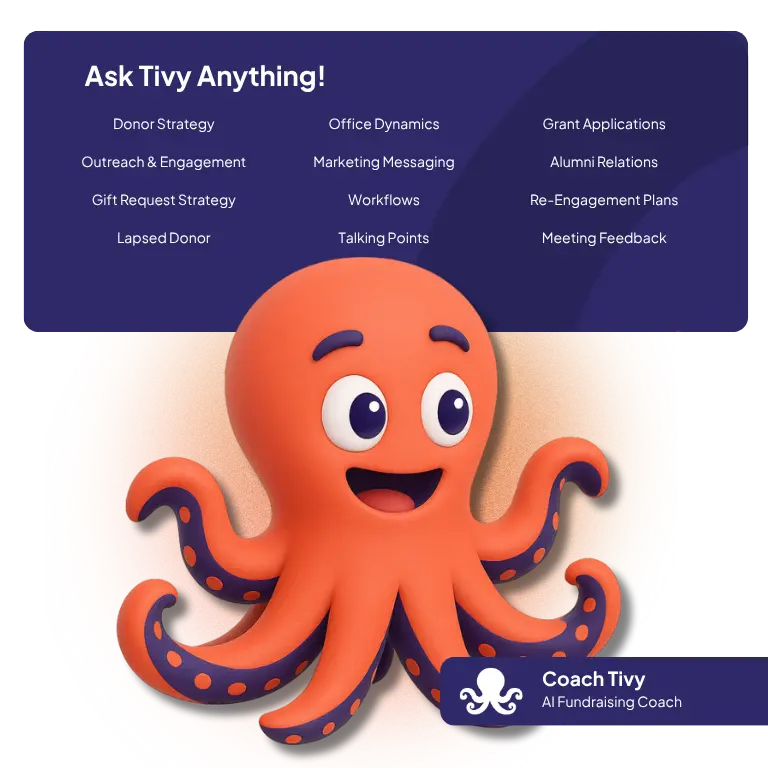
New hires can start practicing real fundraising conversations from week one. They don’t need to wait for a senior fundraiser to have time to role-play with them. Coach Tivy is available whenever they are, including from their phone on the way to a meeting.

Manager dashboards that surface coaching priorities

Instead of guessing where your team needs help, you can see aggregate data on which skills need attention. Maybe your West Coast team is strong on discovery calls but struggling with renewal conversations. Now you know where to focus.

Custom feedback aligned to your organization’s approach

Every organization has its own way of talking about its mission, its own policies, its own culture. With configurable feedback standards, practice, and coaching reflect your organization’s specific approach, not generic fundraising advice.

The Result: Consistency Without Micromanagement

The goal isn’t to replace human managers with technology. It’s to give managers the infrastructure they need to coach effectively at scale. When every fundraiser has access to practice and feedback, managers can focus their limited 1:1 time on the highest-impact coaching conversations rather than covering the basics with everyone.

The organizations that figure this out don’t just have better fundraisers. They have more equitable development programs, faster onboarding, and a shared language for what great fundraising looks like.

Managing a large fundraising team? See how Practivated helps enterprise organizations scale coaching →

Why Your Fundraisers Need Practice, Not Just Training

Every nonprofit invests in training. But what actually moves the needle is fundraiser practice. The deliberate, repeated repetition of real conversations with real feedback.

But here’s the uncomfortable question: If we’re spending so much on training, why do so many fundraisers still feel underprepared for their most important conversations?

The answer isn’t that the training is bad. It’s that training alone isn’t enough.

The Gap Between Knowing and Doing

Think about how we learn any complex skill. Surgeons don’t just study anatomy; they practice on simulations before they operate. Pilots don’t just read flight manuals; they log hundreds of hours in simulators. Athletes don’t just watch game film; they run drills.

Fundraising is a performance skill. It requires reading social cues, managing emotions, adapting in real time, and navigating ambiguity. You can’t learn that from a slide deck.

Yet the standard nonprofit approach is: teach the theory, maybe do a role-play at a conference workshop, and then send fundraisers into the field and hope it sticks.

What the Research Says

The learning science is clear on this. Studies on skill acquisition consistently show that deliberate practice, structured, repeated practice with feedback, is what builds expertise. Not passive learning. Not exposure to information. Practice.

Here’s what the research tells us:

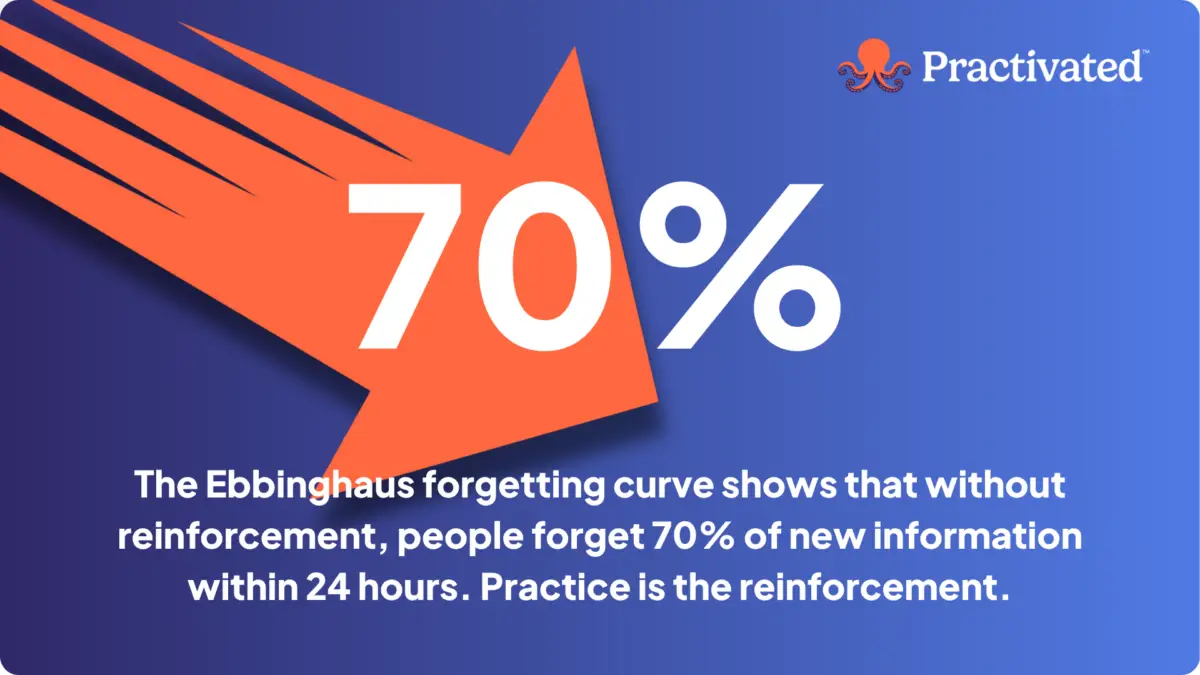
  • Retention drops sharply without practice. The Ebbinghaus forgetting curve shows that without reinforcement, people forget 70% of new information within 24 hours. Practice is the reinforcement.
  • Confidence comes from repetition, not information. A fundraiser who has practiced a major gift ask five times will walk into that conversation differently than one who attended a workshop on major gifts.
  • Feedback accelerates growth. Practice without feedback is just repetition. Practice with specific, actionable feedback is how skills actually develop.

What Practice-Based Development Looks Like

So what does it mean to shift from a training-first model to a practice-first model?

It means your fundraisers can:

  • Rehearse specific conversations before they happen, not generic scenarios, but the actual ask they’re making next Tuesday
  • Get immediate, specific feedback on what they did well and where they can improve, not a grade, but coaching
  • Build muscle memory through repetition so that the skills become automatic, not something they have to consciously remember
  • Practice safely in a low-stakes environment where mistakes are learning opportunities, not lost donations

This is what Practivated was built to do. Coach Tivy doesn’t replace your training programs; she makes them stick by giving every fundraiser a place to practice what they’ve learned, get feedback, and build real confidence.

The Shift Is Happening

More and more nonprofit leaders are recognizing that their fundraisers need reps, not just resources. They’re building practice into weekly routines, using simulation as part of onboarding, and measuring skill development over time rather than just tracking workshop attendance.

The organizations that make this shift don’t just have better-trained fundraisers. They have more confident ones. And confident fundraisers raise more money.

Ready to move from training to practice? Learn how Practivated helps fundraising teams build real skills→

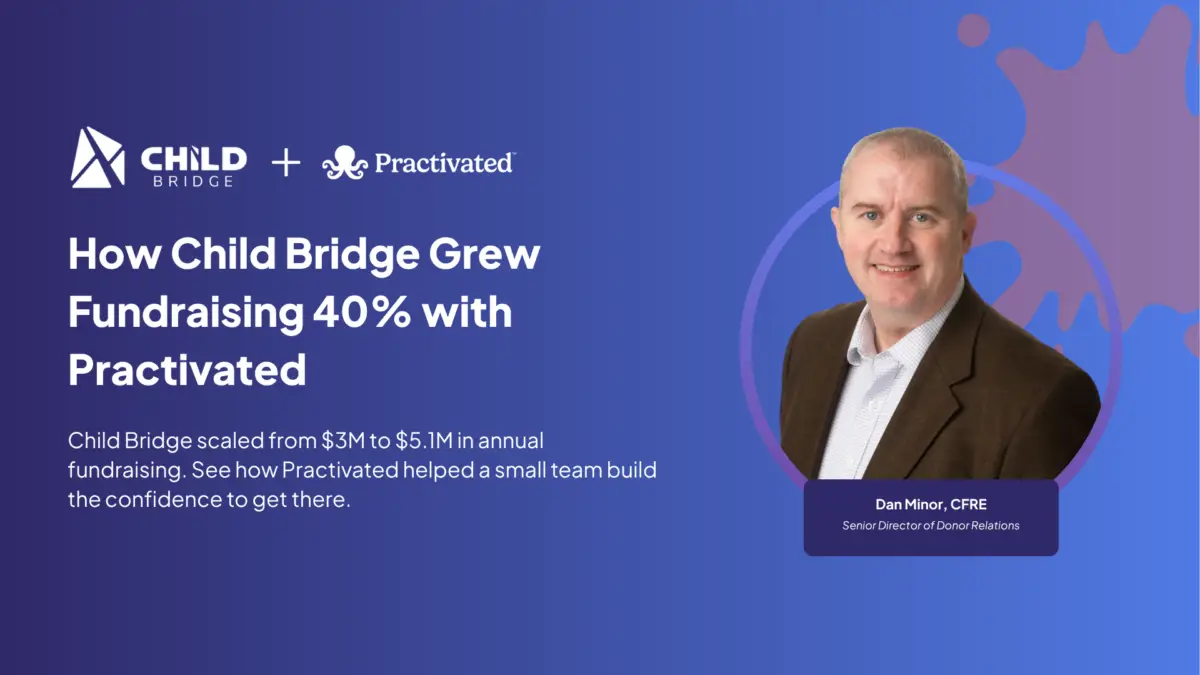
How Child Bridge Grew Fundraising 40% with Practivated

The Challenge

When Dan Minor joined Child Bridge in October 2023, the organization was at an inflection point. Founded fifteen years earlier, Child Bridge had grown into a statewide presence across Montana with six offices—but its fundraising operations still depended heavily on the personal relationships of its co-founder, Mary, who was preparing to step back.

Dan inherited a contracted grant writer and hired two more team members Brennan (spring 2024) and Raychelle (summer 2025) as associate directors of donor relations. Their executive director who also manages a donor portfolio was hired in March 2024. The challenge was clear—how do you scale fundraising operations from a founder-dependent model into a sustainable, team-driven engine capable of doubling revenue?

“When I came on board, we were a $3 million organization,” Dan explains. “Mary told me: in a couple of years, I anticipate we’ll be $5 million. I need someone to build the capacity and scale the fundraising operations.”

Dan’s team members were at different experience levels. Brennan, who managed mid-level and monthly donors, had been on the team just over a year. Raychelle, overseeing major donors and estate planning, was brand new. The executive director, while experienced, was deeply task-oriented and needed support shifting toward more strategic donor engagement. And Dan himself, a 17-year veteran of fundraising, was juggling the dual responsibilities of managing his own portfolio while mentoring a growing team.

Professional development options were limited. The team had invested in modules through Veritus Group, but Dan needed something different—a platform that could meet each team member where they were and give them structured, ongoing support.

Discovering Practivated

Dan first encountered Practivated at a Montana conference where Mallory Erickson’s books were being sold. He picked up a copy, started reading, subscribed to the podcast, and found himself hooked. After 17 years in fundraising, Mallory’s approach offered both affirmation and rejuvenation.

“I’ve been in fundraising for 17 years. For me, it’s been a nice level of affirmation and also rejuvenation—kind of recalibrating, looking at some habits, what are good, what are bad.” — Dan Minor, CFRE

In June 2025, Dan took a demo with Allie Jewell on the Practivated team. What struck him immediately was the platform’s simulation feature—AI-powered avatars that let fundraisers practice real donor conversations at varying difficulty levels and receive detailed, actionable feedback. For Dan, who was investing significant time mentoring his team one-on-one, this was a breakthrough. The platform could provide the repetitions and coaching his team needed, 24/7, without stretching him even thinner.

Within a month, Child Bridge signed on as a team customer—becoming one of Practivated’s earliest organizational partners.

The Implementation

Child Bridge onboarded in July 2025 with the full team—Dan, Brennan, and Raychelle—joining a comprehensive walkthrough of the platform. Even before the formal onboarding, Brennan had already started using the simulation feature to prepare for donor meetings and was seeing results.

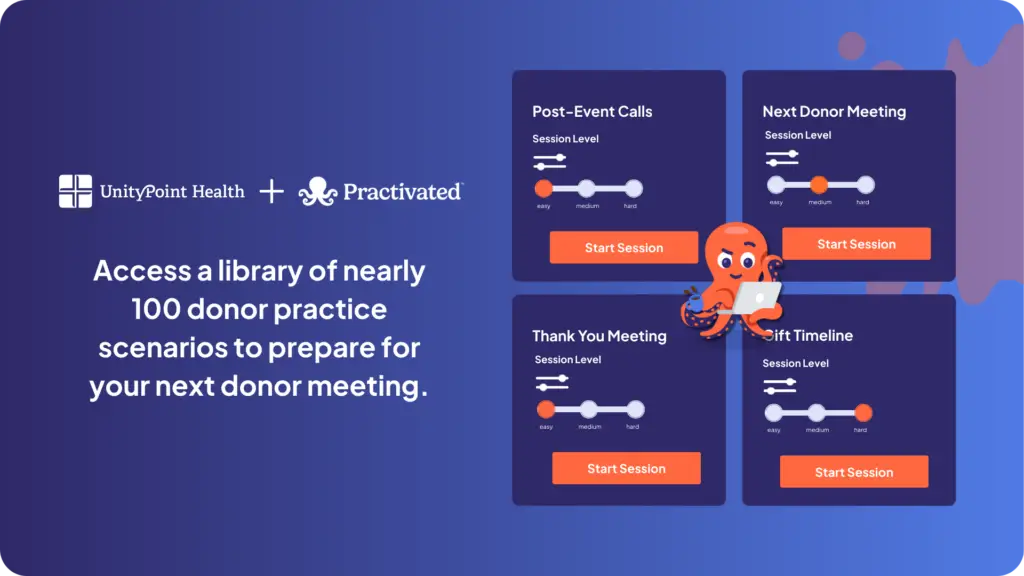
The onboarding focused on three core capabilities that aligned with Child Bridge’s needs: practice scenarios that let fundraisers simulate challenging donor conversations at adjustable difficulty levels; donor profiles that the team could customize with real portfolio data for targeted practice; and Coach Tivy, Practivated’s AI coaching tool, which provides on-demand guidance for fundraising strategy and donor communication.

As the platform evolved, Child Bridge’s usage deepened. By early 2026, Charlotte introduced the program marketplace—structured, guided training experiences that walk fundraisers through specific skill areas step by step. Dan also leveraged Practivated’s data-informed donor profiles to build customized practice scenarios based on Child Bridge’s own data modeling, which had segmented their 2,500 donor records into 68 distinct groups.

The Results

Revenue Growth: In less than two years, Child Bridge grew from a $3 million organization to $5.1 million in annual fundraising—a 40% increase. Dan credits this growth to a combination of strengthened donor relationships, improved team confidence, and more strategic conversations with donors at every level.

Donor Retention: Child Bridge maintained a 67% donor retention rate, well above the national average, even as they aggressively pursued new donor acquisition.

Team Development: Each member of the fundraising team has used Practivated to sharpen their approach. Brennan has applied it to monthly donor strategies and mid-level stewardship. Raychellel has used donor simulations to prepare for major gift conversations. And the executive director has used it to refine her own engagement style.

Strategic Planning: Dan has built a comprehensive plan to reach $6.5 million by 2028 through a major donor acquisition campaign targeting 55,000 households in Montana—launching during Foster Care Awareness Month in May. Practivated’s custom programs are helping the team prepare for the surge in new donor relationships this campaign will generate.

“I’m super stoked about what we are building for 2028—a sustainable fundraising engine. I look forward to the continued partnership with Practivated.” — Dan Minor, CFRE

What’s Next

Child Bridge renewed and expanded their Practivated partnership in March 2026, adding customizations tailored to their donor segments—including a program focused on reactivating high-potential lapsed donors and another for engaging younger professionals through digital communications and monthly giving.

Dan is also planning to hire a new development coordinator and is exploring Practivated’s onboarding tools to reduce ramp-up time for new team members. With a $5 million budget this year and sights set on $6.5 million by 2028, Child Bridge is building the kind of fundraising infrastructure that will serve Montana’s foster and adoptive families for decades to come.

And at the center of that engine? A team that practices, improves, and shows up to every donor conversation with confidence.

Ready to Build a More Confident Fundraising Team?

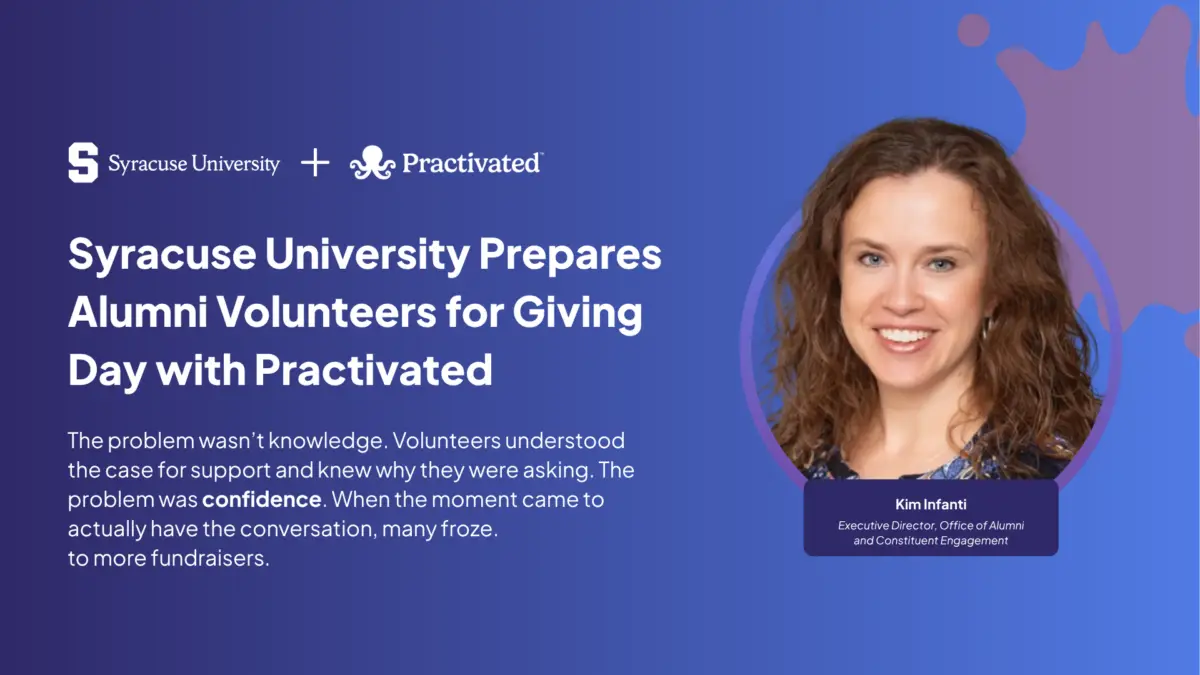
Syracuse University Prepares Alumni Volunteers for Giving Day with Practivated

The Challenge

Syracuse University’s Office of Alumni and Constituent Engagement runs a robust peer-to-peer fundraising strategy for its annual Giving Day. Board members and key alumni volunteers are recruited to reach out to classmates and friends via email, text, and phone to encourage gifts to the university.

The problem wasn’t knowledge. Volunteers understood the case for support and knew why they were asking. The problem was confidence. When the moment came to actually have the conversation, many froze.

Kim Infanti, Executive Director of Alumni and Constituent Engagement, identified several recurring objections that tripped volunteers up: donors saying “Syracuse already has a huge endowment,” or “I’m still paying back my college loans.” Volunteers also struggled when conversations veered off-topic, like alumni frustrated about changes in athletics. These are real, emotionally charged moments that no amount of reading a script can prepare you for.

Traditional role-play training couldn’t scale to the number of volunteers Syracuse needed to prepare, and it was difficult to create realistic, repeatable practice opportunities in the limited time before Giving Day.

The Solution

Kim partnered with Practivated to support Syracuse’s philanthropy committee, all volunteer leaders, as they prepared for Giving Day.

Kim and Mallory Erickson (Practivated’s Founder & CEO) worked together to build custom practice scenarios tailored to Syracuse’s specific challenges, including:

  • Calling a classmate to ask for their first-ever gift to Syracuse
  • Responding to “But Syracuse already has a ton of money”
  • Navigating conversations that veer into athletics frustrations

Volunteers practiced these real, dynamic donor conversations in Practivated’s low-stakes AI-powered environment—building the muscle memory and confidence they needed before reaching out to actual donors.

Because Practivated doesn’t require any data integration or access to sensitive donor information, the platform was easy to implement without going through a lengthy IT review process which is a critical factor for a university setting.

The Results (In Kim’s Words)

“One of the hardest parts of preparing alumni volunteers to ask their classmates for gifts isn’t providing them with the content, it’s building their confidence. Board members and key alumni volunteers can know why they’re asking and understand the case for support, but still freeze the moment they’re actually in the conversation.

Practivated changes that. The ability to practice real, dynamic donor scenarios in a low-stakes environment is exactly what volunteer training has been missing. After just one hour in Practivated, our volunteers shared that they felt more at ease and definitely more ready to actually make the ask for Syracuse Giving Day.

For any advancement team working on a peer-to-peer strategy, this tool is relevant with very real results, and it’s also so much fun!” 

— Kim Infanti

Executive Director, Office of Alumni and Constituent Engagement

Confidence Isn’t a Nice to Have. It’s the Foundation Your Fundraising Team Is Built On.

There's a conversation happening in fundraising...

And it usually sounds something like this: “I just want my team to feel more confident going into donor meetings.” It gets said warmly, hopefully, the way we talk about things we care about but don’t quite know how to fix. And then it gets moved to the bottom of the priority list, because there are campaign deadlines to hit and major gift portfolios to manage and a hundred other things that feel more urgent.

Here’s what that approach is costing you.

Confidence is not a soft skill sitting at the edges of your fundraising strategy. It is not a nice to have, a bonus outcome, or the kind of thing you circle back to when things slow down. It is the single variable that determines whether all of the strategy, research, and relationship-building your team invests in actually translates into results or stalls out the moment someone sits across from a donor and doesn’t quite believe they deserve to be there.

When we treat confidence as an afterthought, we’re not just leaving a development opportunity on the table. We’re leaving money there too.

The Real Cost of Low Confidence and Why We Rarely Measure It

The reason confidence rarely gets treated as a revenue issue is that its costs are diffuse. They don’t show up as a single line item. They show up as a pattern of asks that were too small, conversations that plateaued before they should have, and hours of mental energy spent on a single donor interaction long after it ended. And when those patterns compound across a team of five, ten, or twenty fundraisers over the course of a year, the financial impact is significant — it’s just invisible.

Let’s name two of the most common ways this plays out.

The first is down-selling your offer. When a fundraiser walks into a donor conversation without a deep sense of grounded confidence, they adjust. They ask for less than they know the donor could give. They undervalue the impact of the work, the urgency of the mission, and the quality of the relationship they’ve spent months building. This isn’t a character flaw — it’s what human beings do when we don’t feel fully prepared for a high-stakes moment. We protect ourselves by asking for what feels safe rather than what’s true. Research confirms what most fundraising leaders already sense: donors respond most generously to fundraisers who show up with clarity, preparation, and genuine conviction in their ask. When that conviction is absent, donors feel it too — and they respond accordingly.

The second cost is the one we talk about even less: the time and mental bandwidth lost to rumination. Preparation and rumination can look similar from the outside, but they function completely differently. Preparation is intentional and forward-moving. Rumination is repetitive and draining — it’s the loop of second-guessing that takes over after a difficult donor conversation, the spiral that starts when a follow-up goes unanswered, the quiet erosion of confidence that makes the next outreach harder to initiate. Research on work-related rumination consistently shows it’s associated with significant deficits in executive functioning — the very cognitive skills fundraisers need most when they’re building relationships and managing complex donor portfolios. In one study, 80% of employees reported experiencing what researchers call “productivity anxiety,” with many experiencing it multiple times a week. For fundraisers, who operate in an environment of ongoing high-stakes interpersonal work, the toll is even sharper.

And here’s what makes this particularly costly for organizations: that self-doubt doesn’t stay contained to one person or one conversation. It spreads. A fundraiser who is stuck processing a difficult interaction isn’t reaching out to other donors. They’re not building momentum on their portfolio. The ripple effect moves quietly through a team, and most leaders don’t connect it to the revenue gap they’re trying to close.

What We've Gotten Wrong About Confidence

For too long, the fundraising sector has treated confidence as a personality trait — something you either have or you don’t, something that develops over time through experience alone, something that can’t really be taught or systematically built. But that framing isn’t just inaccurate; it’s actively harmful, because it lets organizations off the hook from providing the infrastructure their teams need to grow.

The research is clear: confidence is built through repetition and feedback, not through knowledge accumulation or the passage of time. A fundraiser can understand every principle of major gift cultivation and still feel paralyzed in the moment, because knowing something and being able to execute it under pressure are entirely different things. The Bridgespan Group has found that fundraisers who practice their donor conversations regularly are meaningfully more likely to secure major gifts — not because practice makes perfect, but because practice builds the kind of embodied fluency that allows someone to be fully present in a conversation rather than managing their own anxiety through it.

This is what deliberate practice does for fundraisers. It doesn’t eliminate the stakes. It allows them to meet the stakes prepared.

So the real question for fundraising leaders isn’t whether your team lacks confidence — it’s whether you’ve given them any structured, consistent way to build it. And for most teams, the honest answer is that you haven’t, because until recently, no infrastructure existed to make that possible.

What Fundraising Teams Actually Need to Build Confidence at Scale

When we think about how we’ve tried to address the confidence gap historically, the solutions have been well-intentioned but undersized: a half-day training, a manager-led role-play before a major ask, an occasional one-on-one where someone can talk through a difficult conversation. These things have value, but they don’t create the kind of continuous, private, feedback-rich practice environment that actually moves the needle on confidence over time.

What fundraisers need — and what we built Practivated to provide — is a repeatable, low-pressure space to practice the real moments of fundraising work before they happen in real life. Not a simulation designed to feel like a test, but a genuine practice environment where fundraisers can explore different approaches, make mistakes without consequence, work through the questions they’re most anxious about, and walk away with something concrete: a clearer sense of what they want to say, how they want to say it, and why it matters.

At the center of that experience is Coach Tivy, our on-demand AI fundraising coach built specifically for the nuanced, relational work of nonprofit fundraising. Coach Tivy isn’t a general-purpose AI tool repurposed for your team — it was designed from the ground up around the dynamics of donor conversations, the psychology of generous giving, and the real moments where fundraisers most need support. Whether someone is preparing for a first major gift conversation, working through how to respond to a sensitive donor question, or processing a meeting that didn’t go the way they hoped, Coach Tivy is available immediately, without the scheduling friction and “calendar guilt” that so often limits access to real coaching.

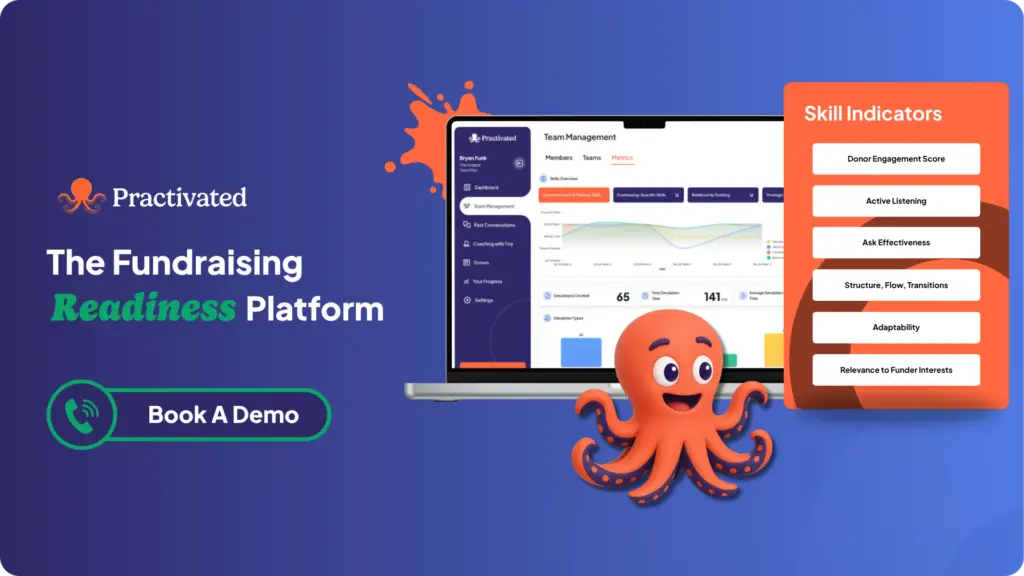
Privacy is foundational to how Practivated works, and it matters more than it might seem. When fundraisers know that their practice sessions are genuinely private — that they can ask the questions they’d be embarrassed to ask their manager, try approaches that might not work, and learn without the fear of judgment — they practice more, they go deeper, and they grow faster. Leaders, meanwhile, gain access to team-level insights: where the skill gaps are, what kinds of conversations the team is struggling with, where additional coaching or support would have the most impact. It’s the kind of visibility that strengthens a team without eroding the trust that makes good fundraising possible in the first place.

What This Looks Like in Practice

When the University of Texas at El Paso integrated Practivated into their onboarding process and weekly rhythms, the results were striking. Two new advancement officers who onboarded with the platform showed a 280% increase in outreach and donor engagement within their first 30 days compared to a prior officer who hadn’t used it. Beyond the numbers, leadership noticed a qualitative shift in how their one-on-ones functioned: conversations that had previously been spent on basic triage and problem-solving moved toward higher-level strategy, because fundraisers were arriving more prepared and more confident in their own judgment.

At PeaceHealth, the philanthropy team completed more than 140 practice simulations in their first 30 days on the platform, with an average session length of seven minutes — short enough to fit into a real workday, long enough to be genuinely useful. Teams reported using the platform not just for structured practice, but for drafting donor communications, preparing for upcoming meetings, and processing conversations after the fact. The shift they described wasn’t abstract: it was a movement from hesitation to clarity, from the weight of pressure to the steadiness of preparation.

These results reflect something we believe deeply at Practivated: that when fundraisers are given the right tools and a real place to practice, they don’t just perform better in individual conversations. They show up differently across their entire portfolio. They take more initiative. They ask for more. They stay in the work longer, with less of the burnout that comes from carrying high-stakes performance anxiety without any structured way to process it.

The Shift That Changes Everything

If the fundraisers on your team are under-asking, if they’re spending the hours after a difficult donor conversation in a spiral of second-guessing, if your newer staff are taking longer than you’d like to find their footing — those aren’t signs of people who lack potential. They’re signs of people who haven’t been given a structured place to practice.

Confidence isn’t something your team needs to arrive with. It’s something you can build together, systematically, through consistent practice and the kind of feedback that actually sticks. That’s what Practivated was created for. Not to replace the human work of fundraising — the relationships, the intuition, the genuine connection between a fundraiser and the people who believe in the mission — but to give your team the foundation they need to do that human work with more clarity, more courage, and more impact.

One conversation at a time.

Ready To See How Practivated Can Help Your Team Build Ask Confidence?

Onboard New Fundraisers 280% Faster

Here's a scenario that happens at organizations everywhere, all the time:

You finally hire a new fundraiser. You’re excited because you believe they’re talented, mission-aligned, and they’re eager to get started. You invest weeks (sometimes months) in onboarding them. CRM training, program deep-dives, shadowing calls, reviewing the case for support.

And then you send them out to meet with donors.

Six months later, they leave.

Maybe they told you they “just weren’t cut out for fundraising.” Maybe they found something else. Maybe they stuck around longer but never quite hit their stride (always hesitating before the big conversations, always finding reasons to delay the ask).

You might think those are stories about bad fundraisers but a lot of the time, they are stories about what happens when we set people up to fail.

The Real Cost of "Not Ready Yet"

When a new fundraiser isn’t ready to have real donor conversations, the consequences ripple out in every direction.

There’s the obvious cost: you’re paying a full salary for someone who isn’t yet generating revenue. Depending on the role, that’s $100,000 to $300,000 or more per year. If it takes 6-12 months before they’re truly productive, you’re looking at $50,000 to $150,000 in salary alone before you see a return (or know that they were really the right fit).

But that’s just the beginning….

> There are the donors who get a lukewarm first impression and never come back. 

> The prospects who could have been cultivated but weren’t because your new hire wasn’t confident enough to pick up the phone. 

> The relationships that stalled because a fundraiser talked around the ask instead of making it.

> There are the gifts that simply never happened because nobody was ready to invite them to give.

And there’s something else that rarely gets talked about: the cost to your senior fundraisers. Every hour they spend coaching, role-playing, and hand-holding a new hire is an hour they’re not spending with their own donors. Your best people become de facto trainers, and their portfolios suffer for it.

This isn’t sustainable. And most organizations know it but they just don’t know what else to do.

The Gap Traditional Onboarding Can't Close

Most onboarding programs do an excellent job teaching fundraisers what they need to know. The problem is that knowledge doesn’t equal readiness.

I’ve trained over 100,000 fundraisers at this point, and here’s what I can tell you: you can know exactly how to make an ask, but if you’ve never said those words out loud (if you’ve never felt your nervous system spike and figured out how to push through the discomfort) your skills actually decrease in the moments that matter most.

This is about our biology. Our nervous systems are designed to protect us from perceived threats. And for most people, asking someone for a large sum of money feels threatening. So our bodies do what they’re designed to do and tell us to avoid, delay, or freeze.

The only way through this is repetition, feedback, and muscle memory. You build readiness through practice where you actually say the words, feel the discomfort, and build the muscle memory to move through it.

But until now, the only way to get that practice was in high-stakes situations with real donors, where real relationships and real dollars were on the line.

Managers don’t have 30 minutes to role-play with every fundraiser before every meeting. And even when they do, it’s awkward, inconsistent, and impossible to scale.

So we keep sending people into donor meetings before they are ready, and then we wonder why they struggled, why they left, and why the cycle kept repeating.

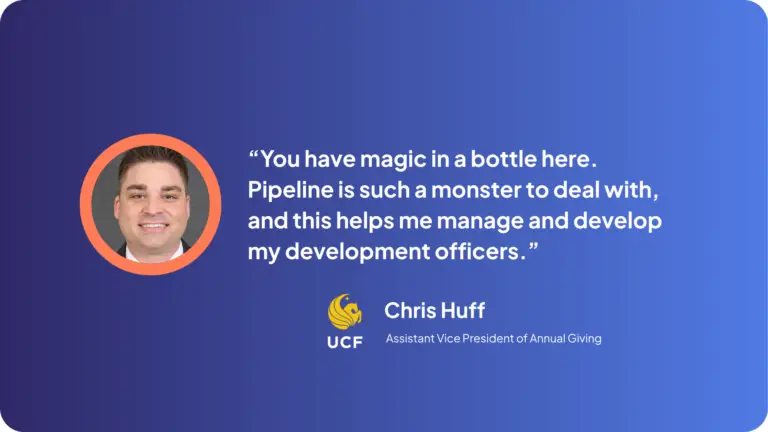
What UTEP and UCF Figured Out

When the University of Texas at El Paso brought on new gift officers, they ran into the same challenge every advancement team faces: traditional training got fundraisers to a certain point, but there was still a gap between knowing the strategy and being able to execute it.

Fundraisers understood the case for support. They could articulate the mission. But when it came time to navigate a real donor conversation (especially the hard parts) they hesitated.

So UTEP integrated Practivated into their onboarding program.

The result: new fundraisers reported feeling ready to get in front of donors 280% faster than their peers who didn’t use the platform.

That’s the difference between a fundraiser who’s productive in weeks versus one who’s still finding their footing after three months. It translates into months of salary recouped, donor relationships that actually move forward, and senior fundraisers who can focus on their own portfolios instead of constantly coaching new hires.

One UCF fundraiser spent just 10 minutes practicing a challenging donor conversation with Tivy (our AI coach) and then closed an unexpected $5,000 gift because he walked into that meeting prepared, regulated, and ready.

What Readiness Actually Looks Like

Readiness is about skills, clarity, muscle memory, and confidence. It’s not about personality or being a “natural” at fundraising (because as we all know, transferable skills don’t always transfer).

Readiness is about having done the hard thing enough times (in a safe environment) that your body knows how to respond when it matters.

It looks like….

  • The fundraiser who can make the ask without their voice getting tight, because they’ve already made it fifty times.
  • The gift officer who can navigate an unexpected objection without freezing, because they’ve practiced recovering from curveballs.
  • The new hire who gets in front of donors in their first month (and actually moves relationships forward) because they don’t have to wait until real stakes to figure out what to say.

This is what Practivated makes possible through dynamic training and repetition with real-time feedback, personalized coaching, and the ability to build muscle memory that no webinar or workshop can provide.

The Math That Changes the Conversation

If your average new fundraiser takes 9 months to become fully productive, and Practivated cuts that to 3 months, you’ve just recovered 6 months of salary. On a $200,000 hire, that’s roughly $100,000.

But the real ROI isn’t just in salary savings, it’s also in the gifts that happen because your fundraiser was ready to ask, the donors who stay engaged because they had a great first conversation, and the reduced turnover because your people actually feel equipped to succeed.

It’s also in your senior team getting their time back, so they can focus on the work only they can do.

If you’re doing the math on what slow onboarding is actually costing your organization—let’s talk.

Ready To See How Practivated Can Help Your Team Build Ask Confidence?

Improve Ask Effectiveness 33% by Next Month

We Analyzed 370 Simulated Donor Meetings

Here’s something I’ve noticed after analyzing 370 simulated donor meetings across 106 fundraisers inside Practivated: 90% of conversations actually improve donor sentiment. Fundraisers are doing the hard work of building rapport, establishing trust, and creating genuine connections.

However, too many of those same fundraisers still hesitate when it comes time to make the offer.

I see this pattern constantly, and it used to be my pattern too. We can passionately articulate the importance of our programs when we’re in the field, connecting with the people we serve. But the moment we sit down across from a donor with the intention to invite them into partnership our sense of purpose and confidence disappear. 

Our palms clench. 

Our hearts race. 

And we find ourselves stumbling through the ask (or skipping it entirely).

This gap is costing organizations millions in unrealized gifts. 

What Gets in the Way

When fundraisers approach the ask moment, their nervous systems often interpret it as a threat. That’s not about weakness, it’s a normal biological reaction. We have a nervous system that is more than 500 million years old, and it’s trained to keep us safe. The problem is, our brain doesn’t distinguish between asking someone for $50,000 and being chased by a bear. Both can trigger the same protective responses: fight, flight, or freeze.

The result is that fundraisers unconsciously sabotage their own asks in predictable ways by burying the number at the end of a long explanation or framing the offer as a question rather than an invitation. Sometimes they present a caveat or justification immediately after stating the amount, filling that crucial silence instead of holding space for the donor to process. And sometimes, they skip the ask entirely and tell themselves “the timing wasn’t right.”

It makes perfect sense that this is what happens when fundraisers are asked to perform high-stakes conversations they’ve never actually experienced.

If you are one of these people, I want you to know that you’re not alone. And you are not a “bad fundraiser” because you feel uncomfortable or resistant when it comes time to make the offer. It makes perfect sense that this would stress you out. 

But although it might feel like it when it comes to the level of stress in your body, that donor isn’t a lion trying to eat you.

What Creates Better Ask Effectiveness

The good news is that our data from the State of Donor Conversations Report reveals something I’ve seen over and over again: fundraisers who run through conversation scenarios ahead of time, repeatedly show measurable improvement. And those who use feedback grow faster and stronger.

This isn’t rocket science, but it is counter to how most organizations approach fundraising development. Our industry typically sends people to conferences, or gives them scripts. We tell them what to say in a generic way, and then we put them in front of donors and hope they are able to translate all of that content into dynamic relationship-based context.

But information doesn’t create transformation. Knowing what to say and being able to say it under pressure are completely different things.

What actually moves the needle on ask effectiveness comes down to a few key elements. 

  1. Repetition in low-stakes environments. Your fundraisers need to hear themselves make offers (out loud, in conversation) before they do it with a real donor. They need to practice being clear, specific, and direct. 
  2. Second, they need real-time feedback that’s specific enough to act on. General advice like “be more confident” doesn’t help. Feedback like “you qualified your ask immediately after stating the number, try holding space instead” does.
  3. Third, they need to build tolerance for discomfort. That pause after an offer feels eternal. Fundraisers need to experience that pause repeatedly until their nervous systems stop interpreting it as danger.

What We're Seeing Inside Practivated

The State of Donor Conversations Report gave us a clear picture of where fundraisers are strong and where they’re struggling. Confidence, clarity, and relevance are clear strengths across teams. Fundraisers know their missions, they believe in their work, and they genuinely care about donors.

But structure and making the offer remain the most common growth opportunities. And this is exactly where repetition makes the biggest difference.

When fundraisers use Practivated to practice their offers (with AI-simulated donors who respond realistically and our AI coach Tivy who provides immediate, specific feedback) we see rapid improvement. It doesn’t take years, it takes minutes and weeks. 

The 33% improvement in ask effectiveness is what becomes possible in one month when fundraisers finally have a safe space to practice the hardest part of their job.

Here's What I Want You to Know

If your fundraisers are having good conversations but not closing gifts, the solution isn’t more training content. They need repetition, muscle memory, and feedback.

Every donor meeting is an investment of time, relationship capital, and organizational resources. When your fundraiser hesitates on the offer (or skips it entirely) that investment doesn’t pay off.

There is a different, better, and more sustainable way forward. When we honor the deep relationship between our minds and bodies, when we give fundraisers the opportunity to practice in environments that feel safe, fundraising can shift from something we dread to something that feels connected and empowering.

Ready To See How Practivated Can Help Your Team Build Ask Confidence?

How AI Coaching Helped Double an Annual Leadership Gift at UnityPoint Health

About the Customer

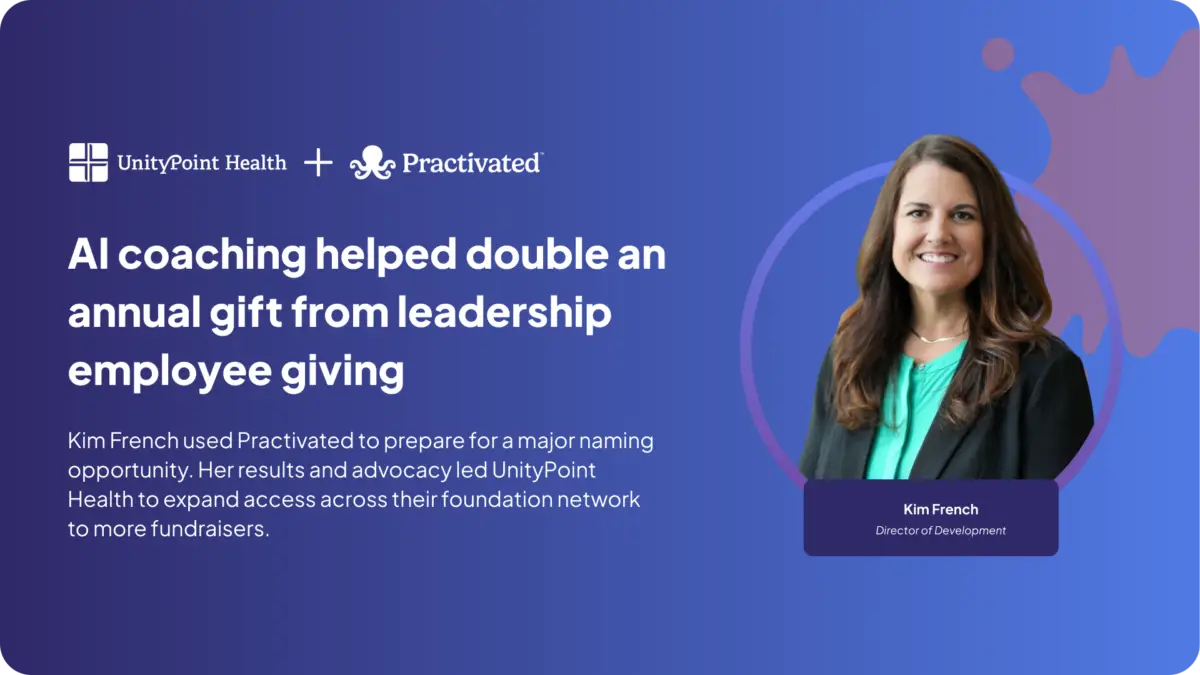
Kim French is the Development Director at the Allen Foundation, a healthcare foundation serving UnityPoint Health in Waterloo, Iowa. A natural relationship-builder with deep roots in her community, Kim has spent over a decade in foundation work and her entire career connected to the hospital system she serves.

Kim embodies what great healthcare fundraising looks like: she’s passionate about her mission, beloved by her donors, and consistently delivers results. When a donor recently walked in to make a gift after receiving a hospice brochure, Kim lit up describing the interaction: “This is why I love doing what I do.”

Her leadership recognized her talent early. Jake Heuser, VP of System Philanthropy for UnityPoint Health, describes Kim as “one of our very, very, very best” and credits her with remarkable growth: “A year and a half ago, we’re sitting in our portfolio review meeting, and she’s like, ‘Jake, you don’t understand. My portfolio is leadership annual employee giving.’ And a year after that, she’s like, ‘I’m never going back to leadership annual employee giving. I can actually start raising.'”

But even top performers face moments where they want more support—especially when preparing for conversations that push them beyond their comfort zone.

The Challenge

Kim’s foundation, like many healthcare shops, didn’t have a formal practice culture.

“We don’t do any role playing in our foundation, you know, as far as with our coworkers and stuff. So I think that’s why the Practivated is super important, like, for me, because we don’t do that here.”

And when she did imagine practicing with colleagues, Kim recognized the limitations: “I feel like if I would role play with my friend here in my office, she’s not gonna give me constructive feedback. You know what I mean? She’s gonna say, oh, you did great. Don’t you know, that was awesome.”

Kim had strong instincts and genuine donor relationships. But when it came to preparing for high-stakes conversations—particularly making specific asks for significant amounts—she wanted a way to practice that would genuinely challenge her.

“I can talk to people out of the blue. I mean, I have no problems talking to people, but actually sometimes making a specific ask for a specific dollar amount is hard for me. Like, I’ll ask people to consider a naming opportunity and here’s the levels or, you know, things like that. But to ask somebody for half a million or a million dollars is something I’ve never done before.”

So, when Kim learned she could have that type of conversation for the first time in a safe and private environment (instead of with an actual donor) she jumped into the product as fast as she could. And her reaction? “I was blown away.”

How Practivated Helps

Kim quickly discovered that Practivated filled a critical gap in her professional development—and fit seamlessly into her busy schedule.

Realistic Donor Simulations

Kim created a custom donor avatar to prepare for a major naming opportunity—her biggest ask ever. After her first practice session, she was impressed by how authentic it felt:

“I was impressed by what the donor was saying. You know what I mean? The voice didn’t sound too AI-ish. The voice sounded real. It really felt like you were talking to somebody. And just all the different interesting things that he said and brought up to, like, switch the conversation a little bit, I thought was really cool.”

Preparing for Unexpected Objections

The real power of Practivated became clear when Kim learned about a potential concern her donor might raise—something she hadn’t anticipated. She immediately went into Practivated to practice that exact scenario.

“I put that in the comments, you know, and then I asked Coach Tivy about it afterwards. And so, I mean, it was really good. So he asked the right questions.”

Coach Tivy helped her develop a thoughtful response strategy she could bring into the real conversation. Kim valued that she didn’t have to figure it out alone: “It just takes, like, ten minutes. You know, it’s not a big time consuming thing.”

Strategic Coaching for Hard-to-Reach Donors

Beyond practice simulations, Kim discovered value in Coach Tivy for brainstorming approaches to challenging situations.

“We have a cardiovascular surgeon at our hospital. He’s our only cardiovascular surgeon. Super busy. And he’s told me before, ‘Kim, I don’t open emails from you. I know you probably just want money.’ So he is really hard to pin down, but I know he always gives every year.”

Kim took the challenge to Coach Tivy: “I told Coach Tivy, like, exactly just what I said. You know, I had this cardiovascular surgeon. He’s hard to get ahold of. I wanna talk to him about our new career pathways program… How is my best approach? And we kinda went back and forth, and she gave me some ideas.” 

She particularly valued being able to save those insights: “That’s what I liked about the Coach Tivy thing too. You can save the transcript. You’re not, like, trying to jot down stuff that she said a million miles an hour. You can look at the transcript and figure out what she just told you.”

Fits Into a Busy Fundraiser’s Life

“I can do it when I want to. It literally takes ten minutes. I don’t have to go to a conference to learn some of this stuff. You can just do it on your own time when you have time.”

And the coaching conversations naturally evolve based on what Kim needs: “I feel like I had my first conversation with the donor, and then I clicked on Talk to Tivy and the feedback thing. And that conversation did go—I asked her then about a doctor that I’m trying to get ahold of. And then we just totally switched conversations, and she started talking about that. I was like, woah. It wasn’t just about what was just said.”

Case Study Assets (3)

The Impact

Confidence for Her Biggest Ask

Kim walked into her major gift meeting feeling prepared for every scenario—including objections she hadn’t initially anticipated.

“I felt totally prepared after I practiced with Practivated. It just boosted my confidence level through the roof.”

While the naming gift ultimately didn’t close due to the donor’s family considerations, the relationship remained strong. In fact, the donor doubled their annual gift the following year—a testament to how Kim’s confident, well-prepared approach strengthened trust.

“I’m keeping him close to the vest. He just doubled his donation this year. So I feel good, you know, even though he said no when I asked about naming.”

Feedback That Goes Beyond What Humans Can Provide

Kim experienced something in Practivated that she couldn’t get anywhere else—instant, comprehensive feedback.

“The stuff that I got from Coach Tivy at the end was, like, I couldn’t—you know? I just couldn’t get that anywhere else.”

When Mallory noted that even as a coach, she couldn’t listen to a conversation and instantly give feedback on 16 indicators, Kim agreed: “I haven’t heard anything where Coach Tivy said something like, ‘What is she talking about?’ I have not heard that at all. So, no, I don’t know how you created that, but it’s really good.”

A Champion Who Spreads the Word

Kim didn’t just use Practivated—she became a huge advocate. She shared transcripts with her team, posted about it on LinkedIn, and brought it to leadership’s attention.

“I sent it to everyone. Like, look at this.”

The Ripple Effect: UnityPoint Health Expands Access

Kim’s enthusiasm and results caught the attention of Jake Heuser, VP of System Philanthropy for UnityPoint Health, who oversees fundraising across 12 foundations.

Jake witnessed Kim’s growth trajectory and recognized the role Practivated played: “She’s a great example of putting the right tools with the right person.”

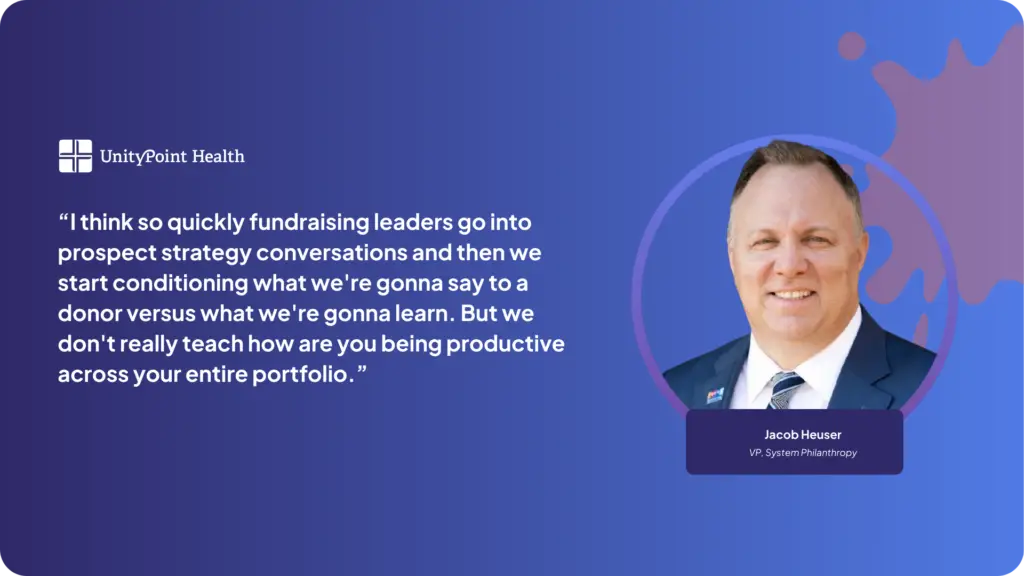
He sees the broader need across the industry: “I think so quickly fundraising leaders go into prospect strategy conversations—’Tell me what we’re gonna do about this’—and then we start conditioning what we’re gonna say to a donor versus what we’re gonna learn. But we don’t really teach how are you being productive across your entire portfolio.”

Case Study Assets (2)

Jake understands the confidence barrier fundraisers face: “We have that anxiety wall that we gotta break through oftentimes. It’s kinda like what ChatGPT has done. It’s kinda what the calculator did forty-five years ago. You start to realize that we’re binding up our relationship talents and our arts and overthinking some of this stuff.”

Based on Kim’s results and advocacy, UnityPoint Health expanded access to Practivated for more fundraisers across their foundation network—a direct result of one fundraiser’s willingness to invest in herself, share what she learned, and champion a tool she believed in.

Why Kim Believes Every Fundraiser Benefits from Practice

Kim is clear-eyed about what fundraising actually requires—even for the most experienced professionals:

“Every fundraiser is gonna have questions like, ‘How should I handle this?’ You really wanna be thoughtful about how you approach someone or something. You just don’t wanna fly off the cuff.”

“Why not have a coach in your ear that can say, ‘Hey. Have you thought about this?’ or ‘Try that?’ Sometimes people will tell you things that you didn’t think about.”

“I feel like you can build your confidence better on this than if you just role played with another coworker.”