How Child Bridge Grew Fundraising 40% with Practivated

The Challenge

When Dan Minor joined Child Bridge in October 2023, the organization was at an inflection point. Founded fifteen years earlier, Child Bridge had grown into a statewide presence across Montana with six offices—but its fundraising operations still depended heavily on the personal relationships of its co-founder, Mary, who was preparing to step back.

Dan inherited a contracted grant writer and hired two more team members Brennan (spring 2024) and Raychelle (summer 2025) as associate directors of donor relations. Their executive director who also manages a donor portfolio was hired in March 2024. The challenge was clear—how do you scale fundraising operations from a founder-dependent model into a sustainable, team-driven engine capable of doubling revenue?

“When I came on board, we were a $3 million organization,” Dan explains. “Mary told me: in a couple of years, I anticipate we’ll be $5 million. I need someone to build the capacity and scale the fundraising operations.”

Dan’s team members were at different experience levels. Brennan, who managed mid-level and monthly donors, had been on the team just over a year. Raychelle, overseeing major donors and estate planning, was brand new. The executive director, while experienced, was deeply task-oriented and needed support shifting toward more strategic donor engagement. And Dan himself, a 17-year veteran of fundraising, was juggling the dual responsibilities of managing his own portfolio while mentoring a growing team.

Professional development options were limited. The team had invested in modules through Veritus Group, but Dan needed something different—a platform that could meet each team member where they were and give them structured, ongoing support.

Discovering Practivated

Dan first encountered Practivated at a Montana conference where Mallory Erickson’s books were being sold. He picked up a copy, started reading, subscribed to the podcast, and found himself hooked. After 17 years in fundraising, Mallory’s approach offered both affirmation and rejuvenation.

“I’ve been in fundraising for 17 years. For me, it’s been a nice level of affirmation and also rejuvenation—kind of recalibrating, looking at some habits, what are good, what are bad.” — Dan Minor, CFRE

In June 2025, Dan took a demo with Allie Jewell on the Practivated team. What struck him immediately was the platform’s simulation feature—AI-powered avatars that let fundraisers practice real donor conversations at varying difficulty levels and receive detailed, actionable feedback. For Dan, who was investing significant time mentoring his team one-on-one, this was a breakthrough. The platform could provide the repetitions and coaching his team needed, 24/7, without stretching him even thinner.

Within a month, Child Bridge signed on as a team customer—becoming one of Practivated’s earliest organizational partners.

The Implementation

Child Bridge onboarded in July 2025 with the full team—Dan, Brennan, and Raychelle—joining a comprehensive walkthrough of the platform. Even before the formal onboarding, Brennan had already started using the simulation feature to prepare for donor meetings and was seeing results.

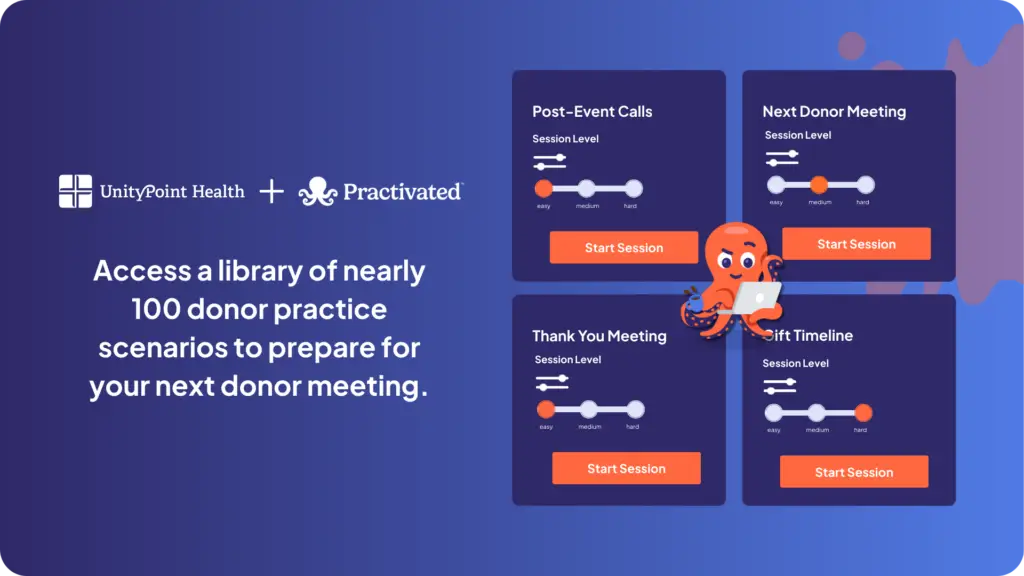
The onboarding focused on three core capabilities that aligned with Child Bridge’s needs: practice scenarios that let fundraisers simulate challenging donor conversations at adjustable difficulty levels; donor profiles that the team could customize with real portfolio data for targeted practice; and Coach Tivy, Practivated’s AI coaching tool, which provides on-demand guidance for fundraising strategy and donor communication.

As the platform evolved, Child Bridge’s usage deepened. By early 2026, Charlotte introduced the program marketplace—structured, guided training experiences that walk fundraisers through specific skill areas step by step. Dan also leveraged Practivated’s data-informed donor profiles to build customized practice scenarios based on Child Bridge’s own data modeling, which had segmented their 2,500 donor records into 68 distinct groups.

The Results

Revenue Growth: In less than two years, Child Bridge grew from a $3 million organization to $5.1 million in annual fundraising—a 40% increase. Dan credits this growth to a combination of strengthened donor relationships, improved team confidence, and more strategic conversations with donors at every level.

Donor Retention: Child Bridge maintained a 67% donor retention rate, well above the national average, even as they aggressively pursued new donor acquisition.

Team Development: Each member of the fundraising team has used Practivated to sharpen their approach. Brennan has applied it to monthly donor strategies and mid-level stewardship. Raychellel has used donor simulations to prepare for major gift conversations. And the executive director has used it to refine her own engagement style.

Strategic Planning: Dan has built a comprehensive plan to reach $6.5 million by 2028 through a major donor acquisition campaign targeting 55,000 households in Montana—launching during Foster Care Awareness Month in May. Practivated’s custom programs are helping the team prepare for the surge in new donor relationships this campaign will generate.

“I’m super stoked about what we are building for 2028—a sustainable fundraising engine. I look forward to the continued partnership with Practivated.” — Dan Minor, CFRE

What’s Next

Child Bridge renewed and expanded their Practivated partnership in March 2026, adding customizations tailored to their donor segments—including a program focused on reactivating high-potential lapsed donors and another for engaging younger professionals through digital communications and monthly giving.

Dan is also planning to hire a new development coordinator and is exploring Practivated’s onboarding tools to reduce ramp-up time for new team members. With a $5 million budget this year and sights set on $6.5 million by 2028, Child Bridge is building the kind of fundraising infrastructure that will serve Montana’s foster and adoptive families for decades to come.

And at the center of that engine? A team that practices, improves, and shows up to every donor conversation with confidence.

Ready to Build a More Confident Fundraising Team?

Syracuse University Prepares Alumni Volunteers for Giving Day with Practivated

The Challenge

Syracuse University’s Office of Alumni and Constituent Engagement runs a robust peer-to-peer fundraising strategy for its annual Giving Day. Board members and key alumni volunteers are recruited to reach out to classmates and friends via email, text, and phone to encourage gifts to the university.

The problem wasn’t knowledge. Volunteers understood the case for support and knew why they were asking. The problem was confidence. When the moment came to actually have the conversation, many froze.

Kim Infanti, Executive Director of Alumni and Constituent Engagement, identified several recurring objections that tripped volunteers up: donors saying “Syracuse already has a huge endowment,” or “I’m still paying back my college loans.” Volunteers also struggled when conversations veered off-topic, like alumni frustrated about changes in athletics. These are real, emotionally charged moments that no amount of reading a script can prepare you for.

Traditional role-play training couldn’t scale to the number of volunteers Syracuse needed to prepare, and it was difficult to create realistic, repeatable practice opportunities in the limited time before Giving Day.

The Solution

Kim partnered with Practivated to support Syracuse’s philanthropy committee, all volunteer leaders, as they prepared for Giving Day.

Kim and Mallory Erickson (Practivated’s Founder & CEO) worked together to build custom practice scenarios tailored to Syracuse’s specific challenges, including:

  • Calling a classmate to ask for their first-ever gift to Syracuse
  • Responding to “But Syracuse already has a ton of money”
  • Navigating conversations that veer into athletics frustrations

Volunteers practiced these real, dynamic donor conversations in Practivated’s low-stakes AI-powered environment—building the muscle memory and confidence they needed before reaching out to actual donors.

Because Practivated doesn’t require any data integration or access to sensitive donor information, the platform was easy to implement without going through a lengthy IT review process which is a critical factor for a university setting.

The Results (In Kim’s Words)

“One of the hardest parts of preparing alumni volunteers to ask their classmates for gifts isn’t providing them with the content, it’s building their confidence. Board members and key alumni volunteers can know why they’re asking and understand the case for support, but still freeze the moment they’re actually in the conversation.

Practivated changes that. The ability to practice real, dynamic donor scenarios in a low-stakes environment is exactly what volunteer training has been missing. After just one hour in Practivated, our volunteers shared that they felt more at ease and definitely more ready to actually make the ask for Syracuse Giving Day.

For any advancement team working on a peer-to-peer strategy, this tool is relevant with very real results, and it’s also so much fun!” 

— Kim Infanti

Executive Director, Office of Alumni and Constituent Engagement

How AI Coaching Helped Double an Annual Leadership Gift at UnityPoint Health

About the Customer

Kim French is the Development Director at the Allen Foundation, a healthcare foundation serving UnityPoint Health in Waterloo, Iowa. A natural relationship-builder with deep roots in her community, Kim has spent over a decade in foundation work and her entire career connected to the hospital system she serves.

Kim embodies what great healthcare fundraising looks like: she’s passionate about her mission, beloved by her donors, and consistently delivers results. When a donor recently walked in to make a gift after receiving a hospice brochure, Kim lit up describing the interaction: “This is why I love doing what I do.”

Her leadership recognized her talent early. Jake Heuser, VP of System Philanthropy for UnityPoint Health, describes Kim as “one of our very, very, very best” and credits her with remarkable growth: “A year and a half ago, we’re sitting in our portfolio review meeting, and she’s like, ‘Jake, you don’t understand. My portfolio is leadership annual employee giving.’ And a year after that, she’s like, ‘I’m never going back to leadership annual employee giving. I can actually start raising.'”

But even top performers face moments where they want more support—especially when preparing for conversations that push them beyond their comfort zone.

The Challenge

Kim’s foundation, like many healthcare shops, didn’t have a formal practice culture.

“We don’t do any role playing in our foundation, you know, as far as with our coworkers and stuff. So I think that’s why the Practivated is super important, like, for me, because we don’t do that here.”

And when she did imagine practicing with colleagues, Kim recognized the limitations: “I feel like if I would role play with my friend here in my office, she’s not gonna give me constructive feedback. You know what I mean? She’s gonna say, oh, you did great. Don’t you know, that was awesome.”

Kim had strong instincts and genuine donor relationships. But when it came to preparing for high-stakes conversations—particularly making specific asks for significant amounts—she wanted a way to practice that would genuinely challenge her.

“I can talk to people out of the blue. I mean, I have no problems talking to people, but actually sometimes making a specific ask for a specific dollar amount is hard for me. Like, I’ll ask people to consider a naming opportunity and here’s the levels or, you know, things like that. But to ask somebody for half a million or a million dollars is something I’ve never done before.”

So, when Kim learned she could have that type of conversation for the first time in a safe and private environment (instead of with an actual donor) she jumped into the product as fast as she could. And her reaction? “I was blown away.”

How Practivated Helps

Kim quickly discovered that Practivated filled a critical gap in her professional development—and fit seamlessly into her busy schedule.

Realistic Donor Simulations

Kim created a custom donor avatar to prepare for a major naming opportunity—her biggest ask ever. After her first practice session, she was impressed by how authentic it felt:

“I was impressed by what the donor was saying. You know what I mean? The voice didn’t sound too AI-ish. The voice sounded real. It really felt like you were talking to somebody. And just all the different interesting things that he said and brought up to, like, switch the conversation a little bit, I thought was really cool.”

Preparing for Unexpected Objections

The real power of Practivated became clear when Kim learned about a potential concern her donor might raise—something she hadn’t anticipated. She immediately went into Practivated to practice that exact scenario.

“I put that in the comments, you know, and then I asked Coach Tivy about it afterwards. And so, I mean, it was really good. So he asked the right questions.”

Coach Tivy helped her develop a thoughtful response strategy she could bring into the real conversation. Kim valued that she didn’t have to figure it out alone: “It just takes, like, ten minutes. You know, it’s not a big time consuming thing.”

Strategic Coaching for Hard-to-Reach Donors

Beyond practice simulations, Kim discovered value in Coach Tivy for brainstorming approaches to challenging situations.

“We have a cardiovascular surgeon at our hospital. He’s our only cardiovascular surgeon. Super busy. And he’s told me before, ‘Kim, I don’t open emails from you. I know you probably just want money.’ So he is really hard to pin down, but I know he always gives every year.”

Kim took the challenge to Coach Tivy: “I told Coach Tivy, like, exactly just what I said. You know, I had this cardiovascular surgeon. He’s hard to get ahold of. I wanna talk to him about our new career pathways program… How is my best approach? And we kinda went back and forth, and she gave me some ideas.” 

She particularly valued being able to save those insights: “That’s what I liked about the Coach Tivy thing too. You can save the transcript. You’re not, like, trying to jot down stuff that she said a million miles an hour. You can look at the transcript and figure out what she just told you.”

Fits Into a Busy Fundraiser’s Life

“I can do it when I want to. It literally takes ten minutes. I don’t have to go to a conference to learn some of this stuff. You can just do it on your own time when you have time.”

And the coaching conversations naturally evolve based on what Kim needs: “I feel like I had my first conversation with the donor, and then I clicked on Talk to Tivy and the feedback thing. And that conversation did go—I asked her then about a doctor that I’m trying to get ahold of. And then we just totally switched conversations, and she started talking about that. I was like, woah. It wasn’t just about what was just said.”

Case Study Assets (3)

The Impact

Confidence for Her Biggest Ask

Kim walked into her major gift meeting feeling prepared for every scenario—including objections she hadn’t initially anticipated.

“I felt totally prepared after I practiced with Practivated. It just boosted my confidence level through the roof.”

While the naming gift ultimately didn’t close due to the donor’s family considerations, the relationship remained strong. In fact, the donor doubled their annual gift the following year—a testament to how Kim’s confident, well-prepared approach strengthened trust.

“I’m keeping him close to the vest. He just doubled his donation this year. So I feel good, you know, even though he said no when I asked about naming.”

Feedback That Goes Beyond What Humans Can Provide

Kim experienced something in Practivated that she couldn’t get anywhere else—instant, comprehensive feedback.

“The stuff that I got from Coach Tivy at the end was, like, I couldn’t—you know? I just couldn’t get that anywhere else.”

When Mallory noted that even as a coach, she couldn’t listen to a conversation and instantly give feedback on 16 indicators, Kim agreed: “I haven’t heard anything where Coach Tivy said something like, ‘What is she talking about?’ I have not heard that at all. So, no, I don’t know how you created that, but it’s really good.”

A Champion Who Spreads the Word

Kim didn’t just use Practivated—she became a huge advocate. She shared transcripts with her team, posted about it on LinkedIn, and brought it to leadership’s attention.

“I sent it to everyone. Like, look at this.”

The Ripple Effect: UnityPoint Health Expands Access

Kim’s enthusiasm and results caught the attention of Jake Heuser, VP of System Philanthropy for UnityPoint Health, who oversees fundraising across 12 foundations.

Jake witnessed Kim’s growth trajectory and recognized the role Practivated played: “She’s a great example of putting the right tools with the right person.”

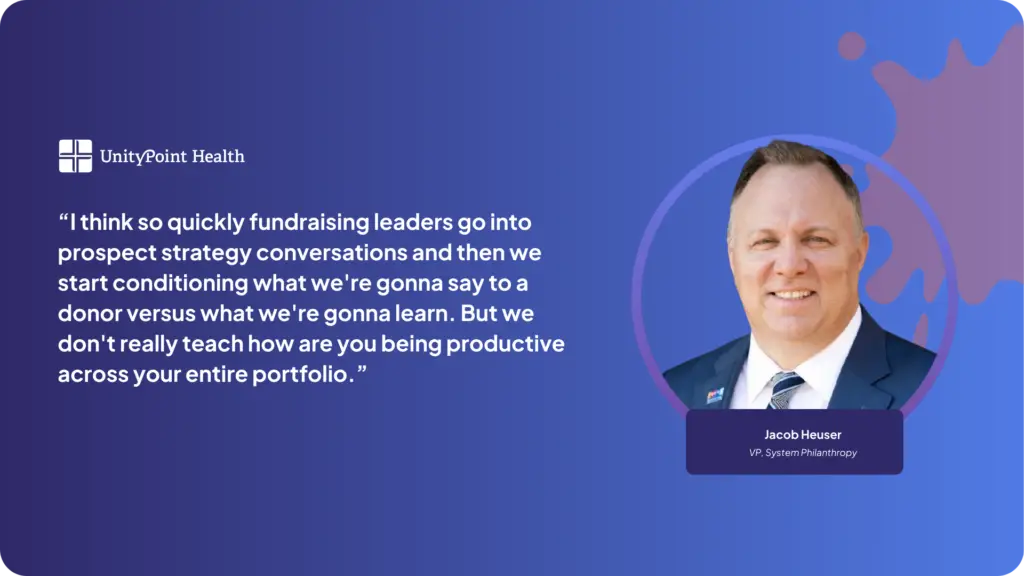
He sees the broader need across the industry: “I think so quickly fundraising leaders go into prospect strategy conversations—’Tell me what we’re gonna do about this’—and then we start conditioning what we’re gonna say to a donor versus what we’re gonna learn. But we don’t really teach how are you being productive across your entire portfolio.”

Case Study Assets (2)

Jake understands the confidence barrier fundraisers face: “We have that anxiety wall that we gotta break through oftentimes. It’s kinda like what ChatGPT has done. It’s kinda what the calculator did forty-five years ago. You start to realize that we’re binding up our relationship talents and our arts and overthinking some of this stuff.”

Based on Kim’s results and advocacy, UnityPoint Health expanded access to Practivated for more fundraisers across their foundation network—a direct result of one fundraiser’s willingness to invest in herself, share what she learned, and champion a tool she believed in.

Why Kim Believes Every Fundraiser Benefits from Practice

Kim is clear-eyed about what fundraising actually requires—even for the most experienced professionals:

“Every fundraiser is gonna have questions like, ‘How should I handle this?’ You really wanna be thoughtful about how you approach someone or something. You just don’t wanna fly off the cuff.”

“Why not have a coach in your ear that can say, ‘Hey. Have you thought about this?’ or ‘Try that?’ Sometimes people will tell you things that you didn’t think about.”

“I feel like you can build your confidence better on this than if you just role played with another coworker.”