
How Fundraising Leaders Are Scaling Fundraiser Coaching Across Large Teams

If you manage a team of three fundraisers, fundraiser coaching can be personal. You know their strengths, their gaps, and their upcoming conversations. You can sit in on calls, debrief afterward, and give tailored guidance.

But what happens when your team is 30 people? Or 100? Or spread across multiple offices, regions, or even countries?

The coaching doesn’t scale. And that’s one of the biggest unspoken challenges in enterprise fundraising.

The Coaching Gap in Large Organizations

Here’s what we hear from fundraising leaders at large nonprofits:

  • “I know my top performers are great, but I have no visibility into what my mid-tier fundraisers are struggling with.”
  • “Onboarding takes months because new hires have to shadow experienced staff, and our experienced staff doesn’t have the bandwidth.”
  • “We do annual training, but there’s no consistency in how skills are reinforced throughout the year.”
  • “Every regional office does things differently. There’s no shared standard for what good fundraising looks like.”

These aren’t training problems. They’re coaching infrastructure problems. The organization has the knowledge, but it just can’t distribute it consistently.

What Scalable Coaching Actually Looks Like

The solution isn’t hiring more coaches (though that would be nice). It’s building systems that deliver coaching-quality development to every fundraiser, regardless of their manager’s bandwidth or their office location.

Here’s what that looks like in practice:

Consistent skill development across locations

Every fundraiser, whether at headquarters or in a satellite office, practices the same core skills and receives feedback against the same standards. No more hoping that the regional manager in Office B is coaching the same way as the one in Office A.

Onboarding that doesn’t depend on shadowing

New hires can start practicing real fundraising conversations from week one. They don’t need to wait for a senior fundraiser to have time to role-play with them. Coach Tivy is available whenever they are, including from their phone on the way to a meeting.

Manager dashboards that surface coaching priorities

Instead of guessing where your team needs help, you can see aggregate data on which skills need attention. Maybe your West Coast team is strong on discovery calls but struggling with renewal conversations. Now you know where to focus.

Custom feedback aligned to your organization’s approach

Every organization has its own way of talking about its mission, its own policies, its own culture. With configurable feedback standards, practice, and coaching reflect your organization’s specific approach, not generic fundraising advice.

The Result: Consistency Without Micromanagement

The goal isn’t to replace human managers with technology. It’s to give managers the infrastructure they need to coach effectively at scale. When every fundraiser has access to practice and feedback, managers can focus their limited 1:1 time on the highest-impact coaching conversations rather than covering the basics with everyone.

The organizations that figure this out don’t just have better fundraisers. They have more equitable development programs, faster onboarding, and a shared language for what great fundraising looks like.

Managing a large fundraising team? See how Practivated helps enterprise organizations scale coaching →
Why Your Fundraisers Need Practice, Not Just Training

Every nonprofit invests in training. But what actually moves the needle is fundraiser practice. The deliberate, repeated repetition of real conversations with real feedback.

But here’s the uncomfortable question: If we’re spending so much on training, why do so many fundraisers still feel underprepared for their most important conversations?

The answer isn’t that the training is bad. It’s that training alone isn’t enough.

The Gap Between Knowing and Doing

Think about how we learn any complex skill. Surgeons don’t just study anatomy; they practice on simulations before they operate. Pilots don’t just read flight manuals; they log hundreds of hours in simulators. Athletes don’t just watch game film; they run drills.

Fundraising is a performance skill. It requires reading social cues, managing emotions, adapting in real time, and navigating ambiguity. You can’t learn that from a slide deck.

Yet the standard nonprofit approach is: teach the theory, maybe do a role-play at a conference workshop, and then send fundraisers into the field and hope it sticks.

What the Research Says

The learning science is clear on this. Studies on skill acquisition consistently show that deliberate practice, structured, repeated practice with feedback, is what builds expertise. Not passive learning. Not exposure to information. Practice.

Here’s what the research tells us:

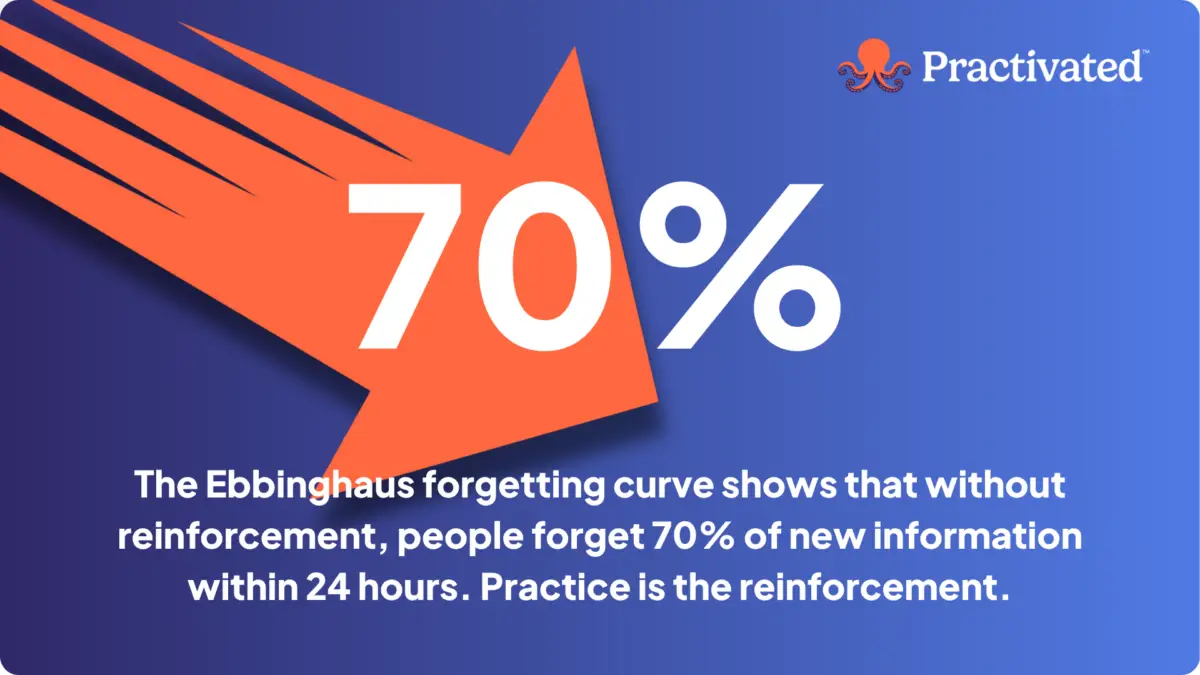
  • Retention drops sharply without practice. The Ebbinghaus forgetting curve shows that without reinforcement, people forget 70% of new information within 24 hours. Practice is the reinforcement.
  • Confidence comes from repetition, not information. A fundraiser who has practiced a major gift ask five times will walk into that conversation differently than one who attended a workshop on major gifts.
  • Feedback accelerates growth. Practice without feedback is just repetition. Practice with specific, actionable feedback is how skills actually develop.

What Practice-Based Development Looks Like

So what does it mean to shift from a training-first model to a practice-first model?

It means your fundraisers can:

  • Rehearse specific conversations before they happen, not generic scenarios, but the actual ask they’re making next Tuesday
  • Get immediate, specific feedback on what they did well and where they can improve, not a grade, but coaching
  • Build muscle memory through repetition so that the skills become automatic, not something they have to consciously remember
  • Practice safely in a low-stakes environment where mistakes are learning opportunities, not lost donations

This is what Practivated was built to do. Coach Tivy doesn’t replace your training programs; she makes them stick by giving every fundraiser a place to practice what they’ve learned, get feedback, and build real confidence.

The Shift Is Happening

More and more nonprofit leaders are recognizing that their fundraisers need reps, not just resources. They’re building practice into weekly routines, using simulation as part of onboarding, and measuring skill development over time rather than just tracking workshop attendance.

The organizations that make this shift don’t just have better-trained fundraisers. They have more confident ones. And confident fundraisers raise more money.

Ready to move from training to practice? Learn how Practivated helps fundraising teams build real skills→