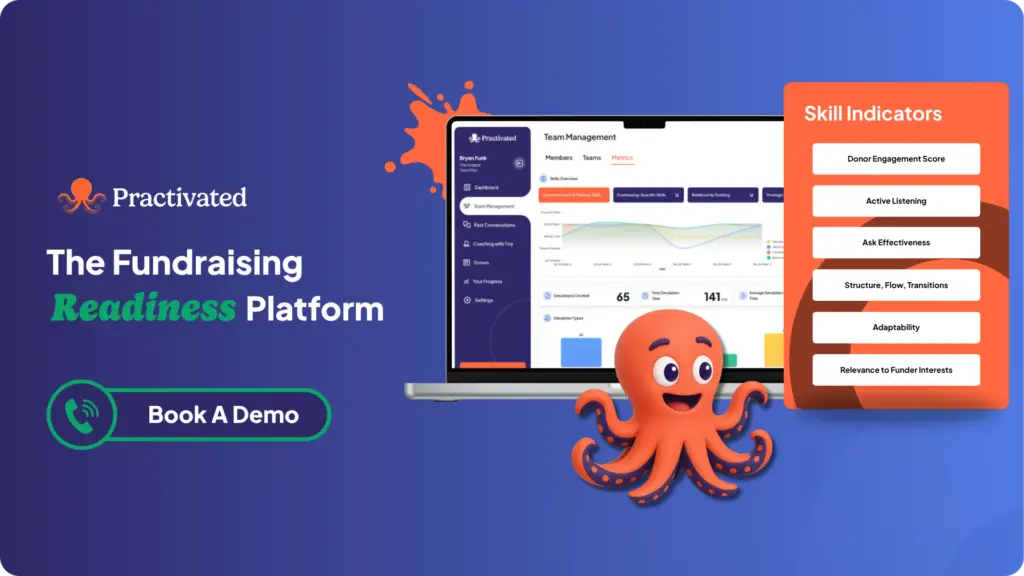
Confidence Isn’t a Nice to Have. It’s the Foundation Your Fundraising Team Is Built On.


There's a conversation happening in fundraising...
And it usually sounds something like this: “I just want my team to feel more confident going into donor meetings.” It gets said warmly, hopefully, the way we talk about things we care about but don’t quite know how to fix. And then it gets moved to the bottom of the priority list, because there are campaign deadlines to hit and major gift portfolios to manage and a hundred other things that feel more urgent.
Here’s what that approach is costing you.
Confidence is not a soft skill sitting at the edges of your fundraising strategy. It is not a nice to have, a bonus outcome, or the kind of thing you circle back to when things slow down. It is the single variable that determines whether all of the strategy, research, and relationship-building your team invests in actually translates into results or stalls out the moment someone sits across from a donor and doesn’t quite believe they deserve to be there.
When we treat confidence as an afterthought, we’re not just leaving a development opportunity on the table. We’re leaving money there too.
The Real Cost of Low Confidence and Why We Rarely Measure It
The reason confidence rarely gets treated as a revenue issue is that its costs are diffuse. They don’t show up as a single line item. They show up as a pattern of asks that were too small, conversations that plateaued before they should have, and hours of mental energy spent on a single donor interaction long after it ended. And when those patterns compound across a team of five, ten, or twenty fundraisers over the course of a year, the financial impact is significant — it’s just invisible.
Let’s name two of the most common ways this plays out.
The first is down-selling your offer. When a fundraiser walks into a donor conversation without a deep sense of grounded confidence, they adjust. They ask for less than they know the donor could give. They undervalue the impact of the work, the urgency of the mission, and the quality of the relationship they’ve spent months building. This isn’t a character flaw — it’s what human beings do when we don’t feel fully prepared for a high-stakes moment. We protect ourselves by asking for what feels safe rather than what’s true. Research confirms what most fundraising leaders already sense: donors respond most generously to fundraisers who show up with clarity, preparation, and genuine conviction in their ask. When that conviction is absent, donors feel it too — and they respond accordingly.
The second cost is the one we talk about even less: the time and mental bandwidth lost to rumination. Preparation and rumination can look similar from the outside, but they function completely differently. Preparation is intentional and forward-moving. Rumination is repetitive and draining — it’s the loop of second-guessing that takes over after a difficult donor conversation, the spiral that starts when a follow-up goes unanswered, the quiet erosion of confidence that makes the next outreach harder to initiate. Research on work-related rumination consistently shows it’s associated with significant deficits in executive functioning — the very cognitive skills fundraisers need most when they’re building relationships and managing complex donor portfolios. In one study, 80% of employees reported experiencing what researchers call “productivity anxiety,” with many experiencing it multiple times a week. For fundraisers, who operate in an environment of ongoing high-stakes interpersonal work, the toll is even sharper.
And here’s what makes this particularly costly for organizations: that self-doubt doesn’t stay contained to one person or one conversation. It spreads. A fundraiser who is stuck processing a difficult interaction isn’t reaching out to other donors. They’re not building momentum on their portfolio. The ripple effect moves quietly through a team, and most leaders don’t connect it to the revenue gap they’re trying to close.
What We've Gotten Wrong About Confidence
For too long, the fundraising sector has treated confidence as a personality trait — something you either have or you don’t, something that develops over time through experience alone, something that can’t really be taught or systematically built. But that framing isn’t just inaccurate; it’s actively harmful, because it lets organizations off the hook from providing the infrastructure their teams need to grow.
The research is clear: confidence is built through repetition and feedback, not through knowledge accumulation or the passage of time. A fundraiser can understand every principle of major gift cultivation and still feel paralyzed in the moment, because knowing something and being able to execute it under pressure are entirely different things. The Bridgespan Group has found that fundraisers who practice their donor conversations regularly are meaningfully more likely to secure major gifts — not because practice makes perfect, but because practice builds the kind of embodied fluency that allows someone to be fully present in a conversation rather than managing their own anxiety through it.
This is what deliberate practice does for fundraisers. It doesn’t eliminate the stakes. It allows them to meet the stakes prepared.
So the real question for fundraising leaders isn’t whether your team lacks confidence — it’s whether you’ve given them any structured, consistent way to build it. And for most teams, the honest answer is that you haven’t, because until recently, no infrastructure existed to make that possible.
What Fundraising Teams Actually Need to Build Confidence at Scale
When we think about how we’ve tried to address the confidence gap historically, the solutions have been well-intentioned but undersized: a half-day training, a manager-led role-play before a major ask, an occasional one-on-one where someone can talk through a difficult conversation. These things have value, but they don’t create the kind of continuous, private, feedback-rich practice environment that actually moves the needle on confidence over time.
What fundraisers need — and what we built Practivated to provide — is a repeatable, low-pressure space to practice the real moments of fundraising work before they happen in real life. Not a simulation designed to feel like a test, but a genuine practice environment where fundraisers can explore different approaches, make mistakes without consequence, work through the questions they’re most anxious about, and walk away with something concrete: a clearer sense of what they want to say, how they want to say it, and why it matters.
At the center of that experience is Coach Tivy, our on-demand AI fundraising coach built specifically for the nuanced, relational work of nonprofit fundraising. Coach Tivy isn’t a general-purpose AI tool repurposed for your team — it was designed from the ground up around the dynamics of donor conversations, the psychology of generous giving, and the real moments where fundraisers most need support. Whether someone is preparing for a first major gift conversation, working through how to respond to a sensitive donor question, or processing a meeting that didn’t go the way they hoped, Coach Tivy is available immediately, without the scheduling friction and “calendar guilt” that so often limits access to real coaching.
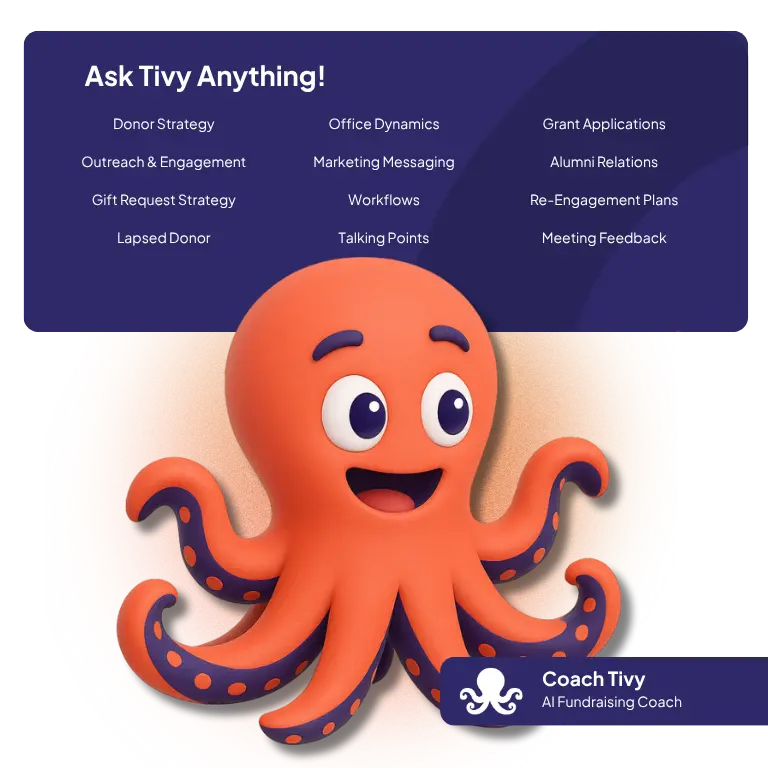
Privacy is foundational to how Practivated works, and it matters more than it might seem. When fundraisers know that their practice sessions are genuinely private — that they can ask the questions they’d be embarrassed to ask their manager, try approaches that might not work, and learn without the fear of judgment — they practice more, they go deeper, and they grow faster. Leaders, meanwhile, gain access to team-level insights: where the skill gaps are, what kinds of conversations the team is struggling with, where additional coaching or support would have the most impact. It’s the kind of visibility that strengthens a team without eroding the trust that makes good fundraising possible in the first place.
What This Looks Like in Practice
When the University of Texas at El Paso integrated Practivated into their onboarding process and weekly rhythms, the results were striking. Two new advancement officers who onboarded with the platform showed a 280% increase in outreach and donor engagement within their first 30 days compared to a prior officer who hadn’t used it. Beyond the numbers, leadership noticed a qualitative shift in how their one-on-ones functioned: conversations that had previously been spent on basic triage and problem-solving moved toward higher-level strategy, because fundraisers were arriving more prepared and more confident in their own judgment.
At PeaceHealth, the philanthropy team completed more than 140 practice simulations in their first 30 days on the platform, with an average session length of seven minutes — short enough to fit into a real workday, long enough to be genuinely useful. Teams reported using the platform not just for structured practice, but for drafting donor communications, preparing for upcoming meetings, and processing conversations after the fact. The shift they described wasn’t abstract: it was a movement from hesitation to clarity, from the weight of pressure to the steadiness of preparation.
These results reflect something we believe deeply at Practivated: that when fundraisers are given the right tools and a real place to practice, they don’t just perform better in individual conversations. They show up differently across their entire portfolio. They take more initiative. They ask for more. They stay in the work longer, with less of the burnout that comes from carrying high-stakes performance anxiety without any structured way to process it.
The Shift That Changes Everything
If the fundraisers on your team are under-asking, if they’re spending the hours after a difficult donor conversation in a spiral of second-guessing, if your newer staff are taking longer than you’d like to find their footing — those aren’t signs of people who lack potential. They’re signs of people who haven’t been given a structured place to practice.
Confidence isn’t something your team needs to arrive with. It’s something you can build together, systematically, through consistent practice and the kind of feedback that actually sticks. That’s what Practivated was created for. Not to replace the human work of fundraising — the relationships, the intuition, the genuine connection between a fundraiser and the people who believe in the mission — but to give your team the foundation they need to do that human work with more clarity, more courage, and more impact.
One conversation at a time.
Ready To See How Practivated Can Help Your Team Build Ask Confidence?